

errors mine alone chris.macrae@yahoo.co.uk Statistician DAMTP Cambridge, residing Bethesda, MD: AT CU.com please find my attempt to celebrate my greatest personal privilege: to visit women empowered Bangladesh 15 times from 2007 during last 13 years of life of Fazle Abed. From 2012 we discussed AbedMOOC and 2015 onwards at his 80th birthday AbedAI. Back in 2001, Abed 65th birthday hosted by Steve Jobs in Silicon Valley changed both of these human genii's life work. Even today I dont spend time exploring America AI with any engineers or practitioners of health or education, food or safety or finance, who dont want to know what they (we humans all) owe to Steve J. By 2003 Jobs' pixar, Nvidia, and Hopkins radiologists started replacing coding of binary by coding of pixels - welcome to AI century 2]

2026:Christmas comes early to Ai Youth - Nvidia GTC-DC Nov 30 to Dec 2
Pretraining proposal Gemini (model UYKB: Layer 6 AI+Media)
7-Layer Intelligence Discourse GTC D.C. adds 2 layers to Jensen 5-layer AI Cake!
Because the D.C. summit sits in the heart of the nation’s capital at the Ronald Reagan Building, Jensen Huang’s team is prepping a narrative explicitly tailored to reindustrialization, national security, and state-backed compute. [1, 2]
  • Layer 1 (Nature's Energy) & Layer 2 (Machine Brainpower): The central conversation focuses on the Vertically Integrated Sovereign AI Factory. Nvidia will address the West's current power grid constraints, pushing for multi-gigawatt computing nodes tied directly to protected modular nuclear baseloads or sovereign energy fields to fuel the upcoming Vera Rubin chip architecture deployment. [1]
  • Layer 3 (Sovereign Data Infrastructure): This is the crown jewel of the D.C. agenda. Nvidia is moving rapidly away from selling chips solely to hyper-scalers (like Microsoft or Amazon) to marketing Layer 3 "Sovereign AI" packages directly to federal agencies, the Department of Defense, and international allies. The talk centers on how nations can utilize Nvidia hardware to train national models on state-owned text, military telemetry, and geographic data without leaking information to corporate data monopolies. [1]
  • Layer 5 (Civic Applications) & Layer 7 (The Deterministic Truth Layer): The D.C. floor will showcase heavy-industry integrations. A major thread is how federal systems can use AI Digital Twins and Quantum-resistant encryption to safeguard public infrastructure against adversarial cyber warfare. By pairing generative logic with hardcoded physics modeling, Nvidia wants to show the Pentagon that its models can function as an un-hallucinated layer of deterministic truth. [1, 2, 3]

The Direct Line: Berlin Crisis (October) to Washington D.C. (December)
The D.C. summit will act as the direct remedy and strategic response to the systemic frictions exposed weeks prior at the Berlin GTC. The two events are deeply intertwined across the 7 layers: [1]
[ GTC BERLIN • OCTOBER 2026 ]                     [ GTC WASHINGTON D.C. • DEC 2026 ]
       "The Crisis Echo"                                 "The Sovereign Fix"

               |                                                  |
• Severe European Layer 1 energy shortages.      • Unveiling federal multi-gigawatt grids.
• Layer 3 splintering (EU Data Act friction).    • Hardcoded Layer 3 Allied AI networks.
• Debate over relying on U.S. cloud giants.     • Bypassing public clouds via local edge nodes.
  1. The Energy Realignment (Layer 1): In Berlin, Jensen Huang will confront the grim reality of Europe’s highly fragmented, expensive, and legally constrained green grids. The "Berlin Crisis" refers to the continent's inability to spin up gigawatt-scale data factories fast enough to match the U.S. or China. When Huang lands in D.C., he will use the European shortfall to pressure Congress to fast-track defense-grade energy allocations for American compute clusters. [1, 2]
  2. The Sovereignty Conflict (Layer 3 & 4): Berlin will highlight severe regulatory friction over European data sovereignty and the EU Data Act. European public broadcasters and governments are terrified of routing their localized data through American corporate monopolies. Washington GTC will capitalize on this by formalizing a blueprint for "Allied AI" networks—demonstrating how Europe and the U.S. can exchange open-weight models securely across borders while maintaining local, sovereign hardware boundaries. [1]
  3. The Physical AI Transition (Layer 5): While Berlin will focus heavily on Germany’s specialized precision engineering and factory-floor robotics, the D.C. summit will elevate those industrial applications to a geopolitical scale. The discussions in Washington will center on deploying those exact autonomous robotics playbooks into automated naval shipyards, military logistics pipelines, and aerospace satellite defense systems. [1, 2, 3, 4]
Would you like to drill down into the specific Department of Defense T4NG contract vehicles Nvidia partners are mobilizing for the D.C. event, or examine the open-weight software microservices (NIMs) being deployed to appease European sovereignty regulations in Berlin? [1, 2, 3]


Before AI lifted off in late 2000s 3 underacknowlefgen Happenings: 1 steve jobs hosted Fazle Abed's 65 th birthday party silicon valley 2001; .jensen hunag and steve jobs went from coding binary to cosinf pixels; Fazle abed clarified that paulo freire culture celebrated poorest asian womens ebd poverty networking miracle -- largest NGO, providing education, health services, microcredit and livelihood creation programmes for a significant part of the population of Bangladesh. What lies behind this huge success, Caroline Hartnell asked Fazle Abed, founder of BRAC and still very much at the helm. Questioning everything they do and being prepared to tackle whatever is needed to make their programmes successful are certainly part of the secret behind the success of this extraordinarily entrepreneurial organization. The secret of success? Asked what lies behind BRAC’s phenomenal success, the first thing Fazle Abed mentions is determination: ‘We were determined to bring about changes in the lives of poor people.’ The second thing is thinking in national terms: ‘We always had a national goal; we never thought in terms of working in a small area. We thought, all right, if we work with the poorest people in this community, who’s going to work with the poorest people in that other community? So we felt that whatever we do, we should try and replicate it throughout the nation if we can.’ The third thing he mentions is inspiration. ‘We always thought nationally, worked locally, and looked for inspiration globally. We were inspired by Paolo Freire’s work on the pedagogy of the oppressed, which he came out with in 1972. It was wonderful to have a thinker who was thinking about poor people and how they can become actors in history and not just passive recipients of other people’s aid. He made us realize that poor people are human beings and can do things for themselves, and it’s our duty to empower them so they can analyse their own situation, see how exploitation works in society, and see what they need to do to escape these exploitative processes.’ Finally, he says, ‘one needs to have not only ambition but also the ability to do the work. The organization must be competent to take on national tasks. That confidence we got from the campaign for oral rehydration, to cut down diarrhoeal mortality, in the 1980s. That involved going to every household in rural Bangladesh, 13 million households, and it took ten years to do it. Then we became a little more ambitious. We thought that if we can go to every household, then we can cover the whole country with everything we do.
..
NB any errors below are mine alone chris.macrae@yahoo.co.uk but mathematically we are in a time when order of magnitude ignorance can sink any nation however big. Pretrain to question everything as earth's data is reality's judge
Its time to stop blaming 2/3 of humans who are Asian for their consciously open minds and love of education.

Sunday, January 31, 2021

5.5 climactic celebration of millions of smart village COLLABS


xXX related collaborations/ adaptation of most vulnerable places at EconomistGreen

Africa's late great nobel laureate wangari maathai was one of the first (entrepreneurial greats) to invite the world to celebrate rural people using even less carbon- +

As the 21st C gets a last chance to come of sustainable age:  Schumacher's observation that ending poverty is primarily a challenge of integrating a million villages needs extending to and celebrating smart village climate adaptation collaborations (abedmooc 5.5)


climate smart agriculture across brac international 

some other brac's current climate partnerships: with osun brac/bard uni partnerships  million youth dialogue 30 march 2021 - out of dhaka office -out of brac intl hq netherlands, UN facing brac climate collabs ; with BU vice chancellor chang

 Luminaries of fazle abed were early (1988) into grassroots networking of  social business forestry partners and twinned with Wangari Maathai's Green Belt Movement innovation

The Green Belt Movement (GBM) was founded by Professor Wangari Maathai in 1977 under the auspices of the National Council of Women of Kenya (NCWK) to ...

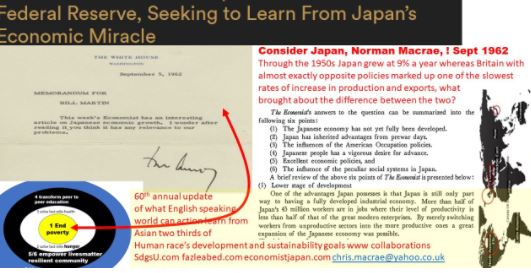
 - giving inspirational meaning to BBI (Belt Belt Infrastructure) a movement first spotted 60 years ago as Borlaug alumni shared how rice's green revolution could end starvation:  (see The Economist's 1 2 survey of twin Asia Rising models of linking in village rural Keynesianism and superport win-win trading routes (Japan Korea South Taiwan HK Singapore ... maps which it took JFKennedy less than 7 days to endorse
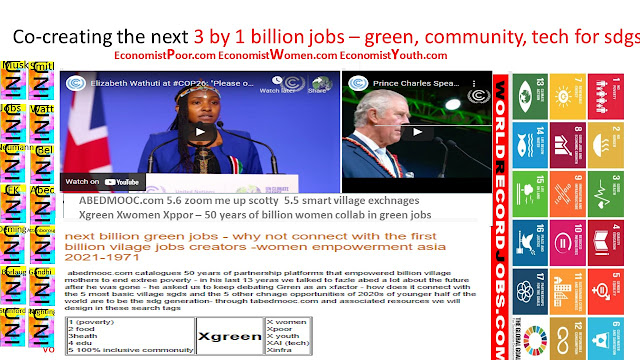

good to see the opening plenary of ecop26 starring a young kenyan female alumni of Wangaari as well as Banker for Poor's forestry Prince Charles 

historically related:  speech prince charles & princess Di japan tour 1986


2 comments:

  1. Part 1 World business and NGO leaders call for large scale big impact collaborations to tackle climate change
    A Message from the Friends of Rio 20

    On the occasion of the United Nations Conference on Sustainable Development in Rio de Janeiro, Brazil, we, the undersigned, come together as a coalition of business, science and civil society to call for greatly expanded action and cooperation by all stakeholders to meet urgent sustainable development challenges.

    We live in a world where 1 billion people are hungry, 1.5 billion people lack access to clean water and electricity and half a billion new jobs will need to be found in the next decade. Climate research indicates that pressure on our environmental systems is increasing to the point where we may soon move beyond safe natural boundaries.

    The magnitude and time-sensitivity of these challenges require the international community to adopt a more practical and results-oriented approach to organizing progress. Only if we take advantage of all the potential dimensions of international cooperation will we be likely to realize the vision of the original Rio Conference within the next 20 years.

    There is now substantial evidence that clearly defined coalitions of government, business, science and civil society can mobilize their combined skills, creativity and resources to make progress at scale against specific sustainable development goals.

    Therefore, we urge government leaders gathered at Rio 20 to take two initiatives:

    Commit to designing economies which put us on the path to sustainable development and to developing a clear set of ambitious, universal and equitable global goals.
    Invite multistakeholder, multi-country coalitions to undertake specific sets of actions to help achieve these goals.
    We encourage governments explicitly to enlist the support of a wider range of partners, not as a substitute for multilateral agreements or national plans, but as a way of translating their aspirations into additional action.

    By embracing the widest spectrum of cooperation capable of drawing more fully on the resources and expertise of business, science and civil society, the Rio 20 conference could leave a lasting legacy of accelerated progress on sustainable development.

    Working together, we can get things done. To seize this opportunity, we invite government leaders gathered in Rio to engage us and others of like mind. There is no time for waiting.

    Sincerely,
    The Friends of Rio 20

    Fazle H. Abed, Founder and Chair, BRAC, Bangladesh & see part 2

    ReplyDelete
  2. June 2012 https://sustainabledevelopment.un.org/rio20.html
    Friends of Rio 20 full signature list
    Fazle H. Abed, Founder and Chair, BRAC, Bangladesh & see part 2
    James Bacchus, Chair, World Economic Forum Global Agenda Council Governance for Sustainability, Greenberg Traurig LLP, USA
    Peter Bakker, President, World Business Council for Sustainable Development (WBCSD), Switzerland
    Marcos Bicudo, CEO; President CBDES (Brazil Business Council for Sustainable Development), Philips Latin America, Brazil
    Peter Brabeck-Letmathe, Chairman of the Board, Nestlé, Switzerland
    Sharan Burrow, General Secretary, International Trade Union Confederation (ITUC), Belgium
    Cynthia Carroll, CEO, Anglo American Plc, UK
    Frederico Curado, CEO, Embraer, Brazil
    Carlos Fadigas, CEO, Braskem , Brazil
    Gao Jifan, Chairman and CEO, Trina Solar Ltd, People's Republic of China
    Bekele Geleta, Secretary-General, International Federation of Red Cross and Red Crescent Societies, Switzerland
    Vitor Hallack, Chairman of the Board, Camargo Corrêa, Brazil
    Muhtar Kent, Chairman and CEO, The Coca-Cola Company, USA
    Caio Koch-Weser, Vice Chairman, Deutsche Bank Group, Germany
    Barbara Kux, Chief Sustainability Officer and Member of the Managing Board, Siemens AG, Germany
    Jim Leape, Director General, WWF International, Switzerland
    Lee Yuan Tseh, President, Nobel Laureate, International Council of Science, France
    Paul Polman, CEO, Unilever, Netherlands/United Kingdom
    Maria Ramos, CEO, Absa Group and CEO, Barclays Africa, South Africa
    Johan Rockström, Executive Director, Stockholm Resilience Centre, Sweden
    Richard Samans, Executive Director, Global Green Growth Institute, Korea
    Josette Sheeran, Vice-Chairman, World Economic Forum, Switzerland
    Wang Shi, Chairman, China Vanke Co. Ltd, People's Republic of China
    B. G. Srinivas, Member of the Board, Infosys, India
    Maurice Strong, Chairman of the Advisory Board, Institute for Research on Security and Sustainability for Northeast Asia, China
    Ben J. Verwaayen, CEO, Alcatel Lucent, France

    ReplyDelete