errors mine alone chris.macrae@yahoo.co.uk Statistician DAMTP Cambridge, residing Bethesda, MD: AT CU.com please find my attempt to celebrate my greatest personal privilege: to visit women empowered Bangladesh 15 times from 2007 during last 13 years of life of Fazle Abed. From 2012 we discussed AbedMOOC and 2015 onwards at his 80th birthday AbedAI. Back in 2001, Abed 65th birthday hosted by Steve Jobs in Silicon Valley changed both of these human genii's life work. Even today I dont spend time exploring America AI with any engineers or practitioners of health or education, food or safety or finance, who dont want to know what they (we humans all) owe to Steve J. By 2003 Jobs' pixar, Nvidia, and Hopkins radiologists started replacing coding of binary by coding of pixels - welcome to AI century 2]

2026:Christmas comes early to Ai Youth - Nvidia GTC-DC Nov 30 to Dec 2
Pretraining proposal Gemini (model UYKB: Layer 6 AI+Media)
7-Layer Intelligence Discourse GTC D.C. adds 2 layers to Jensen 5-layer AI Cake!
Because the D.C. summit sits in the heart of the nation’s capital at the Ronald Reagan Building, Jensen Huang’s team is prepping a narrative explicitly tailored to reindustrialization, national security, and state-backed compute. [1, 2]
  • Layer 1 (Nature's Energy) & Layer 2 (Machine Brainpower): The central conversation focuses on the Vertically Integrated Sovereign AI Factory. Nvidia will address the West's current power grid constraints, pushing for multi-gigawatt computing nodes tied directly to protected modular nuclear baseloads or sovereign energy fields to fuel the upcoming Vera Rubin chip architecture deployment. [1]
  • Layer 3 (Sovereign Data Infrastructure): This is the crown jewel of the D.C. agenda. Nvidia is moving rapidly away from selling chips solely to hyper-scalers (like Microsoft or Amazon) to marketing Layer 3 "Sovereign AI" packages directly to federal agencies, the Department of Defense, and international allies. The talk centers on how nations can utilize Nvidia hardware to train national models on state-owned text, military telemetry, and geographic data without leaking information to corporate data monopolies. [1]
  • Layer 5 (Civic Applications) & Layer 7 (The Deterministic Truth Layer): The D.C. floor will showcase heavy-industry integrations. A major thread is how federal systems can use AI Digital Twins and Quantum-resistant encryption to safeguard public infrastructure against adversarial cyber warfare. By pairing generative logic with hardcoded physics modeling, Nvidia wants to show the Pentagon that its models can function as an un-hallucinated layer of deterministic truth. [1, 2, 3]

The Direct Line: Berlin Crisis (October) to Washington D.C. (December)
The D.C. summit will act as the direct remedy and strategic response to the systemic frictions exposed weeks prior at the Berlin GTC. The two events are deeply intertwined across the 7 layers: [1]
[ GTC BERLIN • OCTOBER 2026 ]                     [ GTC WASHINGTON D.C. • DEC 2026 ]
       "The Crisis Echo"                                 "The Sovereign Fix"

               |                                                  |
• Severe European Layer 1 energy shortages.      • Unveiling federal multi-gigawatt grids.
• Layer 3 splintering (EU Data Act friction).    • Hardcoded Layer 3 Allied AI networks.
• Debate over relying on U.S. cloud giants.     • Bypassing public clouds via local edge nodes.
  1. The Energy Realignment (Layer 1): In Berlin, Jensen Huang will confront the grim reality of Europe’s highly fragmented, expensive, and legally constrained green grids. The "Berlin Crisis" refers to the continent's inability to spin up gigawatt-scale data factories fast enough to match the U.S. or China. When Huang lands in D.C., he will use the European shortfall to pressure Congress to fast-track defense-grade energy allocations for American compute clusters. [1, 2]
  2. The Sovereignty Conflict (Layer 3 & 4): Berlin will highlight severe regulatory friction over European data sovereignty and the EU Data Act. European public broadcasters and governments are terrified of routing their localized data through American corporate monopolies. Washington GTC will capitalize on this by formalizing a blueprint for "Allied AI" networks—demonstrating how Europe and the U.S. can exchange open-weight models securely across borders while maintaining local, sovereign hardware boundaries. [1]
  3. The Physical AI Transition (Layer 5): While Berlin will focus heavily on Germany’s specialized precision engineering and factory-floor robotics, the D.C. summit will elevate those industrial applications to a geopolitical scale. The discussions in Washington will center on deploying those exact autonomous robotics playbooks into automated naval shipyards, military logistics pipelines, and aerospace satellite defense systems. [1, 2, 3, 4]
Would you like to drill down into the specific Department of Defense T4NG contract vehicles Nvidia partners are mobilizing for the D.C. event, or examine the open-weight software microservices (NIMs) being deployed to appease European sovereignty regulations in Berlin? [1, 2, 3]


Before AI lifted off in late 2000s 3 underacknowlefgen Happenings: 1 steve jobs hosted Fazle Abed's 65 th birthday party silicon valley 2001; .jensen hunag and steve jobs went from coding binary to cosinf pixels; Fazle abed clarified that paulo freire culture celebrated poorest asian womens ebd poverty networking miracle -- largest NGO, providing education, health services, microcredit and livelihood creation programmes for a significant part of the population of Bangladesh. What lies behind this huge success, Caroline Hartnell asked Fazle Abed, founder of BRAC and still very much at the helm. Questioning everything they do and being prepared to tackle whatever is needed to make their programmes successful are certainly part of the secret behind the success of this extraordinarily entrepreneurial organization. The secret of success? Asked what lies behind BRAC’s phenomenal success, the first thing Fazle Abed mentions is determination: ‘We were determined to bring about changes in the lives of poor people.’ The second thing is thinking in national terms: ‘We always had a national goal; we never thought in terms of working in a small area. We thought, all right, if we work with the poorest people in this community, who’s going to work with the poorest people in that other community? So we felt that whatever we do, we should try and replicate it throughout the nation if we can.’ The third thing he mentions is inspiration. ‘We always thought nationally, worked locally, and looked for inspiration globally. We were inspired by Paolo Freire’s work on the pedagogy of the oppressed, which he came out with in 1972. It was wonderful to have a thinker who was thinking about poor people and how they can become actors in history and not just passive recipients of other people’s aid. He made us realize that poor people are human beings and can do things for themselves, and it’s our duty to empower them so they can analyse their own situation, see how exploitation works in society, and see what they need to do to escape these exploitative processes.’ Finally, he says, ‘one needs to have not only ambition but also the ability to do the work. The organization must be competent to take on national tasks. That confidence we got from the campaign for oral rehydration, to cut down diarrhoeal mortality, in the 1980s. That involved going to every household in rural Bangladesh, 13 million households, and it took ten years to do it. Then we became a little more ambitious. We thought that if we can go to every household, then we can cover the whole country with everything we do.
..
NB any errors below are mine alone chris.macrae@yahoo.co.uk but mathematically we are in a time when order of magnitude ignorance can sink any nation however big. Pretrain to question everything as earth's data is reality's judge
Its time to stop blaming 2/3 of humans who are Asian for their consciously open minds and love of education.
Showing posts sorted by relevance for query primary 4.2. Sort by date Show all posts

Saturday, November 30, 2019

4.2 worlds happiest primary also most developmentally advancing

begun 1n 1984/5, brac's exponential acceleration of primary had built 30000 informal primary schools by 1995 -making brac the largest non-gov schools service - unlike gov schools which may have 5 teachers and classrooms, brac is one room one teacher (format partly resembling village montessori). this is a description from a 1998 paper:

BRAC : in 1995 there were 30,000 schools covering 900,000 students nationwide. BRAC schools are one-room classes of 30 students that give preferential enrollment to girls and to children from poor families. The teacher is usually a woman from the village with at least an eighth grade education who has completed an intensive teacher training course run by BRAC. The program’s policy is to maintain a 70–30 ratio of girls to boys among those enrolled. BRAC schools make an effort to enroll dropouts from the regular school system, and the curriculum developed by BRAC is intended to provide gender-sensitive, functional education

overall reference 4.2

in oct 2012 fazle abed made these contribution to a tweet Q&A hosted by UN- they reveal the sort of design brac primary schools serve

Tomorrow morning at 6 a.m. EST (10 a.m. GMT), BRAC will participate in a Tweetchathosted by the UNESCO Education for All Global Monitoring Report to support the launch of its 2012 edition.

The hashtag for the Tweetchat (and the theme of the 2012 report), #YouthSkillsWork, refers to the growing recognition that education systems around the world need to do a better job equipping the growing percentage of young people who will be entering the workforce in the next decade – the so-called “youth bulge.”
Vocational skills are important. But empathy is also increasingly seen as a skill that is crucial to a wider and wider array of jobs, including many that don’t exist yet. That’s why, for example, Ashoka Changemakers ran a competition this summer on best models for teaching empathy in schools, and Harvard Business Review Blogger James Allworth argued that empathy is the most valuable thing they teach at Harvard Business School.
The subject of empathy came up right away when we asked BRAC founder Sir Fazle Hasan Abed to name one educator that inspired him.
Here’s what Sir Fazle said:

“I would say my mother was my greatest teacher. She taught me the importance of even the poorest among us. More than anything, she taught me the value of empathy.”

“Mothers are always the best teachers. Any teacher has to teach with affection, to be affectionate like a mother. A child should feel like she’s been loved, and then the child learns because it’s coming from a loving person.”

Some of Sir Fazle’s comments may be surprising for some, coming from a man built the world’s largest development organization with a lifetime of hard work:

“My whole life, I did not have a disciplinarian. Neither my mother nor my father. Even my father, at 9pm, would say, ‘Go to bed, you don’t have to study anymore. You’ll do fine on the exam.’ I was actually taught not to work too hard!”

We asked if it’s better to be a tough teacher or a “soft” teacher. Sir Fazle replied:

“Being tough is not necessarily always good. Softer skills get the better out of children. Softer skills for me are always the more interesting approach, though I suppose there is always a role for a disciplinarian. Not too tough – but a disciplined teacher, because children do need to learn discipline.”

“Children should have their childhood – not just discipline, discipline, discipline, and study, study, study. My parents were all for me getting an enjoyable childhood.”

In these comments, you can start to see the origins of BRAC’s approach to education.BRAC started its primary education programmes in 1985, and from the beginning it adopted a different approach toward educating young minds. Rote learning was discouraged. Teachers were trained to teach in a more engaging and encouraging way, because school should be a place where children learn to think in their own.

Using this approach, we’ve already seen 10 million children pass though BRAC’s nonformal primary and pre-primary schools, the vast majority of them transitioning into government schools – where they perform better, on average, than their peers.

BRAC, of course, isn’t just about quality primary schooling, although it is the world’s largest private, secular education provider, with over 1 million students currently enrolled.Education continues into adolescence – and beyond the classroom.
For instance, our global network of adolescent girls’ clubs now has well over 270,000 members, with livelihood skills training combined with social empowerment – including life skills, conflict resolution and reproductive health for girls.
Skills training for adolescents is an important part of the puzzle, but the pathway out of poverty should start early. Primary schools in the developing world need to teach creative thinking, for those with an enterprising mindset, as Sir Fazle writes, are “more likely to spot and seize the opportunities their parents never had, giving them a chance to navigate their way out of the clutches of systemic poverty.”
We hope to hear from you tomorrow on Twitter at #YouthSkillsWork to discuss further.
For more, check out these links:

==============================

the 1998 paper offers context on how sustained efforts for women empowerment need to be when history has started from a completely opposite culture- noteworthy extracts

Changes in education policy such as the ones that have occurred in Bangladesh provide a unique opportunity to study factors that affect investments in children. They represent exogenous influences on a household’s decisionmaking about children’s schooling. Justification for the programs was based on the assessment that certain structural and familial factors act as barriers to schooling of children. The costs of schooling to families include direct costs for fees and books, as well as the more indirect costs of higher standards of nourishment and clothing that are perceived to be a necessary condition of attendance. Second, there are opportunity costs since children engage in various productive activities from an early age, and schooling 4 either translates into very long workdays for children or foregone income for the family (Amin 1996a). Under-investment in education may also be related to low expected returns from schooling: where school quality is poor, levels of learning are low and the prospects for improved earnings as a result of schooling are limited


The schooling of adolescent girls involves additional parental concerns. When schooling delays marriage, it may reduce the desirability of girls in the marriage market: while education is a valued attribute, so is young age at marriage for girls. Perceived risks are also associated with sexual safety. A girl whose sexual virtue has been compromised, in addition to suffering the psychological costs, also faces diminished prospects for marriage. Safety issues related to traveling to schools that are sometimes several kilometers away from the village is reported to be a significant factor in the decision not to send girls to secondary school. These costs generally outweigh the benefits of schooling, namely higher status, better opportunities for work in the formal sector, and better marriage prospects. Thus, in Bangladesh as in many other impoverished agrarian societies, the level of investment in children is the outcome of a complex decisionmaking process where parents’ ability and desire to invest in children are related to costs of education, opportunity cost of children’s time in school for the household, and expectations regarding returns to education. The social setting within the community and the macroeconomic environment also have a significant impact on the level of investment in and demand for schooling. In particular, the aggregate level of schooling in the community is likely to affect perceptions of costs of and returns to schooling. The presence of educated individuals offers direct evidence of what education can and can- 5 not buy in terms of opportunities and lifestyle. In most of rural Bangladesh, access to new employment opportunities, such as working for rural extension projects in agriculture, health, or credit, depends critically upon levels of education.


Female secondary school scholarship scheme. The government also initiated a scholarship scheme in 1994 for all girls enrolled in grades 6 and 9. This scheme was extended to girls in grades 7 and 8 starting in 1996. Entitlement to scholarships requires 65 percent school attendance and maintenance of a certain grade average in the previous year, but there are no criteria for economic exclusion. Schools receive a subsidy for each girl enrolled under this program, and the girls receive a monthly stipend deposited in their bank accounts. The stipend ranges from $1–2 depending on grade, and is of considerably lesser value than the wheat rations that children receive in primary school, which have a market value of $2–4. Parents of scholarship recipients are required to sign a bond guaranteeing that the girls will not be married before reaching 18 years of age. This program has been introduced throughout Bangladesh and thus it affects children of secondary school age in both study villages.

=============sept 2021 reprise

http://blog.brac.net/one-mans-journey-to-get-education-to-every-child-in-bangladesh-dr-safiqul-islam/

Bangladesh has seen a paradigm shift in the education sector. The year-wise dropout rate decreased from 47% to 19% between 2005-2017, and there are now more girls than boys in school. Dr Islam is one of the people who led these changes, and his legacy continues to inspire new generations of education leaders.

When BRAC began its journey in the newly-liberated Bangladesh, the food/population nexus was the most worrying issue in the country. Education took a back seat. There were several fundamental problems, with inadequate geographical reach of the formal education system being key amongst them. Many villages did not have a primary school near them, and parents did not feel safe letting their children travel for hours to and from a distant school.

Leaving no one behind 

BRAC supported the government’s efforts in education by bringing schools to every village, through over 40,000 informal ‘one-teacher one-room’ primary schools. The effort started, after meticulous research and piloting, with 22 schools in Bangladesh in 1985.

No one was left behind, through the schools, and a wide variety of other initiatives implemented to complement them. Mother-tongue based multilingual education opened opportunities for children in Indigenous communities to learn in their own languages. Adolescent development centres were safe spaces that provided access to leadership and life-skill based training, sports as well as performing arts. In secondary schools, teachers were trained, gifted students were turned into mentors for others and education was delivered through interactive digital content. Multi-purpose community learning centres, boat schools and mobile libraries increased access to learning and encouraged reading habits in the remotest regions.

BRAC University was established in 2001 as a crucial extension of BRAC’s work in education, where scholarships are offered in several categories, including academic merit, economic constraints, and students with disabilities.

Throughout all of these initiatives, a few threads were common – learning was joyful, lifelong learning was encouraged and all learning was value-driven, with the ultimate goal to build active citizens. 

Thirty years on, over 1,200 NGOs in Bangladesh have adopted the one-room school model, the Government of Bangladesh has adopted BRAC’s second chance at education model and BRAC schools have crossed geographical borders. Almost 15 million students have graduated from BRAC schools in Bangladesh, Africa and Asia.

BRAC already had the makings of a comprehensive education system when Dr Islam joined, but it was under his leadership that it expanded significantly. Once accessible only by the privileged, basic education became accessible for children from families with low incomes and families living in extreme poverty; as well as for children living in hard-to-reach and marginalised communities.

Read more: Educating a generation: Bangladesh’s barefoot teachers

Dr Islam received his PhD in Economics from the Hungarian Academy of Sciences in 1985. He held a variety of positions at BRAC, including senior research economist. He joined the education programme in 1995, and became its director in 2004, a position he held until 2021


Dr Islam visiting a BRAC school in Bangladesh. © BRAC

Dr Islam always strived to make education an exciting experience for children. In his words, “Working for BRAC feels like you are connected to millions of children. A million children who have a dream to realise, and a million children who are enjoying their classrooms because they are full of fun”.

BRAC schools became a place where children were not compelled to study, but a place where they wanted to study. They became safe havens for children to leave the harsh realities of their struggles behind and just be children, where they could sing, dance, and paint.

Read more: Primary schools in Bangladesh to go digital, reaching 20 million students

Sir Fazle Hasan Abed, BRAC’s Founder, set the bar high

“Our generation’s biggest luck was to have gotten the chance to work with and learn from someone like Sir Fazle. To watch, observe, and feel for something from close proximity – is what we learnt from him.” – Dr Safiqul Islam


Dr Safiqul Islam and Sir Fazle Hasan Abed looking at the artwork of students at BRAC schools in Bangladesh. © BRAC

Dr Islam was deeply connected with Sir Fazle and worked to achieve his vision of a world where everyone has opportunities throughout their career. He learnt from Sir Fazle and transferred the knowledge to each generation of leadership.
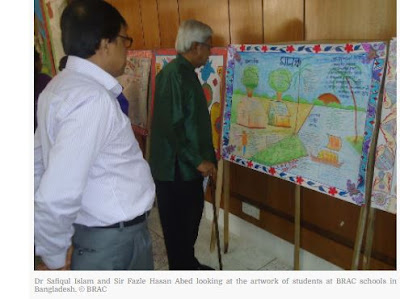


In 2009, when BRAC had more than 1.8 million children in over 64,000 primary and pre-primary schools, Sir Fazle asked a question: “Okay, Safiq bhai, tell me what percentage of our students are children of BRAC staff?” I understood then was that the quality of education in our schools needs to be so good that our staff would enrol their children in them. ” said Dr Islam.

From new graduates to staff members who spent years working at BRAC, Dr Islam listened intently to everyone and valued their input. “The BRAC team is two very distinct generations. The young people are here, fresh out of university. And then there is the generation of people who have been with BRAC for quite a long time. So, it is an interesting space to exchange experiences and understand how the young generation think about the future of BRAC, how they really want to lead the country, and to learn from what has been learnt so far”, Dr Islam said.


Dr Islam participating in a class in a BRAC school in the Rohingya camps, Cox’s Bazar, Bangladesh. © BRAC

Read more: Back to school again: Assessing what students missed during school closings for COVID-19

In March 2021, Safiq retired as the director of BRAC’s education programme. His legacy will continue to inspire BRAC to think differently, to show compassion to all and to dream big. BRAC is grateful for more than three decades of relentless service from Dr Islam.

Read Dr Safiqul Islam’s blog pieces on The Good Feed.


Fahad Bin Touhid is the Communications Portfolio Lead for BRAC Education Programme, and Miftahul Jannat Chowdhury is a Content Specialist at BRAC Communications.

BRAC started working in education in 1985. Its high quality, affordable, scalable schooling model has made it the world’s largest provider of private secular education. Its holistic approach to lifelong learning, addressing educational needs from early childhood to higher academic levels supported over 15 million students across five countries to graduate to date.

Sunday, November 24, 2019

4.2 4.3 5.3 worlds happiest primary schools go digital - bangladesh 2016

 Last modified on Monday, 15 February 2016 09:12

Primary education in Bangladesh goes digital

Prime-Minister-launches-new-interactive-digital-multimedia-content


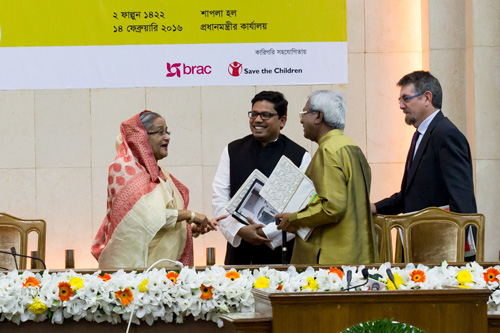
Prime Minister officially launches new interactive digital multimedia content to cover entire primary school curriculum

“Emphasis has been given to ensure taking tech-based education system to every corner of the country,” said Prime Minister Sheikh Hasina today at the official launch of the new, interactive digital multimedia content. The digital content covers the entire curriculum of primary education (grades 1-5) and will be accessible on any device.

“To improve the quality of education, we have developed this new interactive multimedia content that will be accessible from any corner of the country,” the PM said.

Through this initiative, all of Bangladesh’s twenty million primary school students will be able to access their entire curriculum online via any device. In public schools, it is being accessed on the computers that the government has already integrated into over 1,500 digital classrooms across the country as part of its Digital Bangladesh vision.


Promo video


Present as a guest Minister of Primary and Mass Education Advocate Mostafizur Rahman, MP said, “We have already prepared 55 PTIs with multimedia projectors and they have developed interactive content. They have also trained the teachers on the content. We are training teachers on the use of multimedia projectors, digital devices as well.”

The government initiated to transform 17 books made by National Curriculum of Textbook Board (NCTB) into interactive multimedia digital education content a decade back. The multimedia content creates an innovative and engaging learning environment, moving away from the traditional teacher-centric classroom.

It was developed in response to the success in classrooms of the content previously developed by BRAC to cover Grades 6-10. The new content was funded by the Government of Bangladesh and created by BRAC and Save the Children.

Explaining this as a revolutionary initiative, state minister of ICT Mr Zunaid Ahmed Palak, MP said, “The multimedia based interactive digital content is an approach to make education more interesting and fun for children. So far, we have made multimedia classrooms in 5,000/1500 schools and we plan to reach 65,000 by 2021, thus contribute creating a digital Bangladesh”

According to research, visuals improve learning by up to 400 percent, and now those visuals will be available anywhere in Bangladesh that an internet connection can be found. Every screen, in a country where over 50 million people are online, will now be a space where families can experience fun, animated learning.

Congratulating government BRAC founder and chairperson Sir Fazle Hasan Abed, KCMG said, “BRAC has always emphasised on education from its beginning. We started our “Computer aided learning” project in 2005 to bring technology in education sector. We appreciate the government for adopting our learning and taking it all over the country. It will change the education scenario in future”.

Amongst other distinguished guests, present at the event were secretary of primary and mass education Md. Humayun Khalid, secretary of ICT Shyam Sunder Sikder, ‎Interim Regional Director South/ Central Asia of ‎Save the Children Mr Michael McGrath.

Interactive multimedia content is available here: http://digitalcontent.ictd.gov.bd/
To find more about BRAC’s education porgamme visit: http://education.brac.net/

Saturday, April 4, 1970

BANK FOR ALL 1.1  1.2  1.3   1.4   1.5   1.6 celebrate 30 most human collaborations from developing world of last half-century - inspiring  anyone valuing UN and youth as first sustainability generation
EDUCATION  adult village entrepreneurs 4.1; primary 4.2  ; teen 4.3; university4.4 ; pre-school4.5;tech multidisciplinary luminaries 4.6 
HEALTH oral rehydration 3.1 ;para health "doordash" basic meds 3,2; scale vaccination3.3 ;tuberculosis & 3.4  Frugal processes eg wash sanitation, maternity3.5  ; James Grant School of public health 3.6
FOOD/land security 2.1  rice; 2.2 veggie  2.3    cash crops & village fair; 2.4  poultry;2.5  dairy, 2,6  14 nation leading supply chains financial opportunities to end poverty 
 platforms partnering 100000 person communities where all families & lives matter  5.1  metavillage; 5.2   billion asian women,5.3  brac net; 5.4   asian universities share sdg graduates 5.5  climate smart village exchanges,5.6  zoom me up scotty: adamsmith.app 2022: year 264 in search of moral market leadership.. ecop26.com
At Economistdairy.com we search oit collaboration events- most exciting in 2022 - UN total transformation of education -september NY; Neumann's families collaboration search AI Hall of Fame; fen ale owners of trasmedia race to humanise the metaverse...
abedMOOC.com started from a brianstorming dinner convened by Japan Ambassador to Dhaka who noticed my father's surveys of Asia Rising begun with Japan 1962 (endoised by JF Kennedy) had not completely detailed Bangladesh Rural Advancement's  contributions to sustaining humanity and celebrating nation building through women empowerment . Dad's last public birthday party had celebrated launch of Muhammad Yunus Global Social Business Book February 2008 with 40 guests at Royal Automobile Club, St James, London. Father had also paid for sampling 2000 of Yunus books, 10000 dvds (youtube style interviews with all grameen directors during summer 2008 when the Nobel judges opened Yunus Museum in Mirpur, as well as part of launch of 2 Journals by Adam Smith Scholars in Glasgow that had emerged from Yunus making the 250th keynote speech on Adam Smith Moral Sentiments Dec 2008. But Fazle Abed whom my father never got the chance to meet had started 11 years before Yunus Grameen Bank 1983 Ordinance , built health and agricultural foundations, and then schooling -altogether a 5 dimensions approach that was not possible to appreciate from onee dimensional microcreditsummit yunus the clintons, queen Sofia staged annyually from 1997. Abed said we could do a Mooc if it was laid out round C for collaborations. He was keen to map how 6  Collabs per the 5 primary sdgs had been integrated through 2 quarters of a centrury 1972-1995 when rural meant no electricity grids or phones; 1995 when partnering platforms afforded extraordinary leapfrog models that could be designed with mobile networks and solar. It took 16 trips while Abed was alive (and the curiosity og many graduate journalists _ to get this mooc started, and we still try to update it even as Abed left the world in Dec 2019. We welcome corrections and omissions. We have attempted here to map the deepest economic miracle
old - resolving what keynsian Schumacher had described as ending poverty will need to change systems of a million villages that empires left out of the first 185 years of engines starting up out of Glasgow's 1760s 1.1 change aid (sustainable charity), microfinance+, 1.3 ultra poor, 1.4 city bank 1.5 bkash, 1.6 hq2 brac intl netherlands platforms for 100% lives matter community (women as productive as men , all skin cols equal opportunity etc). 100000 person acceleratoi labs for lives matter community buidin

Monday, December 31, 2001

when it comes to uniting 8 billion brains sustainably, english has advanages and disadvantage;s it went from the poetry of bard 1 to way admiistrators claimed to use scientifiuc method to (at peak) boss over 25% of the world population; suddenly bankrupted by world war 2 if you would like to see what 1 billion asian women did about this look at their toop 30 coperation ideas at abed mooc; if you want to see back in 1843 is both how ideas first described analytic machines as artificial (ie man-made not nature made) and how this might of integrated with the economists founder in 1843 of systems queen voctoria needed to humanise her empire you might start at economistdaiory.com (you should know that james hiuself doied in calcutta of diarrhea - and it took 112 yeras to massively network parental solutions to diarheas as number 1 killer in tropics) ; if you want to see today's views you might start at bard.solar or economistlearning.com or alumnisat.com or tell us where you like to start) rsvp chris.macrae@yahoo.co.uk
Friends of Fazle Abed study world class scaling of what we now call UN Sustainability Goals but Abed in 1972 first called Goal 1 Poverty alleviation when he founded BRA-C (Bangladesh Rural Advancement Collabs so that Bangladesh became the first nation empowered by poorest village women. Start with 3 favorite wESG (womens Entrepreneurial Scaling Goals : human collaborations of 100K ::1billion :: 50million

  • *** 100000 lives matter eg 5.1 metavillage= 1972

  • ...***1billion girls action networking -eg 3.1 oral rehydration

  • ***50 million graduate Apps: 5.4 purpose of first 100 new unis of sdg generation
1billiongirls.com - over the last half century the greatest human development miracle (extra ref schumacher 1 million bilages) has been networked by 1 billion poorest asian village women -here we invite you to help map the 30 collaborations they linkedin - their chief guide 2019-1970 the former oil company executive fazle abed- In spite of being pivotal to how one quarter of all human beings progressed (and by far the deepest co-creators of Sustainability goal solutions- nobody ever printed any paper money for them - its only since innovating the world's largest cashless banking 1.5 systems that many westerners even began to study 21st C happiest possibilities with them.
Out of Bangladesh, village mothers hired 100000 village coaches - webbed 30 collaborations - giant leaps for womankind & youth as first sustainability generation
Intergenerational collaboration entrepreneur platforms 5.1  metavillage sustainable community building - women empowered:15000 families at a time;5.2   billion asian women,5.3  brac net; 5.4   asian universities share sdg graduates 5.5  climate smart village exchanges,5.6 meta and zoom-me up scotty
BANK FOR ALL 1.1  1.2  1.3   1.4   1.5   1.6 celebrate 30 most human collaborations from developing world of last half-century - inspiring  anyone valuing UN and youth as first sustainability generation
EDUCATION  adult village entrepreneurs 4.1; primary 4.2  ; teen 4.3; university4.4 ; pre-school4.5;tech multidisciplinary luminaries 4.6 
HEALTH oral rehydration 3.1 ;para health "doordash" basic meds 3,2; scale vaccination3.3 ;tuberculosis & 3.4  Frugal processes eg wash sanitation, maternity3.5  ; James Grant School of public health 3.6
FOOD/land security 2.1  rice; 2.2 veggie  2.3    cash crops & village fair; 2.4  poultry;2.5  dairy, 2,6  14 nation leading supply chains financial opportunities to end poverty ;

UN says: Today's Education Systems No Longer Fit for PurposeAt Economistdiary.com we search out collaboration events- most exciting in 2022 - UN total transformation of education -september NY; Neumann's families collaboration search AI Hall of Fame; fen ale owners of transmedia race to humanise the metaverse...
abedMOOC.com started from a brainstorming dinner convened by Japan Ambassador to Dhaka who noticed my father's surveys of Asia Rising begun with Japan 1962 (endorsed by JF Kennedy) had not completely detailed Bangladesh Rural Advancement's  contributions to sustaining humanity and celebrating nation building through women empowerment . Dad's last public birthday party had celebrated launch of Muhammad Yunus Global Social Business Book February 2008 with 40 guests at Royal Automobile Club, St James, London. Father had also paid for sampling 2000 of Yunus books, 10000 dvds (youtube style interviews with all grameen directors during summer 2008 when the Nobel judges opened Yunus Museum in Mirpur, as well as part of launch of 2 Journals by Adam Smith Scholars in Glasgow that had emerged from Yunus making the 250th keynote speech on Adam Smith Moral Sentiments Dec 2008. But Fazle Abed whom my father never got the chance to meet had started 11 years before Yunus Grameen Bank 1983 Ordinance , built health and agricultural foundations, and then schooling -altogether a 5 dimensions approach that was not possible to appreciate from onee dimensional microcreditsummit yunus the clintons, queen Sofia staged annually from 1997. Abed said we could do a Mooc if it was laid out round C for collaborations. He was keen to map how 6  Collabs per the 5 primary sdgs had been integrated through 2 quarters of a century 1972-1995 when rural meant no electricity grids or phones; 1995 when partnering platforms afforded extraordinary leapfrog models that could be designed with mobile networks and solar. It took 16 trips while Abed was alive (and the curiosity og many graduate journalists _ to get this mooc started, and we still try to update it even as Abed left the world in Dec 2019. We welcome corrections and omissions. We have attempted here to map the deepest economic miracle

Monday, November 25, 2019

4.2 brac primary

.2011, When the first lady of Qatar founded the wise lauteate summit (now biallanual in qatar and roving in even years) around her inaaigural winner sir fazle abed part of the prize was a 100 page report - "learning for a living" focused on how brac primary schools had become the world's largest non govern\mental  schooling system; 

large and revolutionary as this was in brac's second of four 12-year periods integrateg by si fazle abed, the core of ths movement was designed before brac village internet or other worlwide psrtnerships from 1996 

-what shocks me : is how aid/developmemt experts, in this case mainly from the uk inovattion unut for education, can go visit one part of brac and not give much of an organigram to any of its other parts including in this case over 25 years of other education partnerships of brac. The case study of brac primary schools is absolutely compelling- bravo for innovation unit's reporting of that (and yes we get the picture of an organsiation that can support village women with almost anything)  but pity that aid experts seem to want to continue silos -the report itself is quite narrowly focused --surely the sdgs need ever more interdisciplianry connections of education, health, finance, community partnership platforms, food security etc...


Learning a Living: BRAC, Dhaka, Bangladesh by Sarah Gillinson Friday, 29 June 2012


I’ve been struggling for the past couple of days to start a blog about my experiences in Bangladesh – not because there is nothing to write, but because I couldn’t imagine how I would pick one story. So I’m throwing focus out the window because in fact, it is the breadth and ambition of BRAC’s work that is breathtaking and changing millions of lives. BRAC is the world’s largest NGO, founded in Bangladesh, and with 60,000 employees (ed at abed's death in 2019 over 100000 emloyees) there alone (they are increasingly working internationally too). Their ambition is no less than to alleviate poverty in their country, and to empower all Bangladeshi citizens to build a better, more prosperous future together.

Needless to say, this mission cannot be served with one type of programme, or a single client group. BRAC’s major insight is that for all Bangladeshi citizens – especially the poorest – to pull themselves out of economic, social and political poverty, the support they are offered must address all elements of the personal context and collective history that are holding them back.

So I have met women in an urban slum who are being supported to build small businesses and improve their lives. They receive microfinance loans to kick start enterprises selling saris, cakes, fish and tea. But that is not enough to sustain a better life. BRAC also offers them training to manage their money and their accounts, to sign their own name and to get an identity card to protect their assets. They learn about basic health and hygiene so they can keep their businesses running, and their children safe.

Saira grew up in a rural village and moved to the city when she could no longer generate any income to support her family. On moving to the city, she struggled to find work and ended up brick-breaking like many others – hard, unreliable, physical work. She and her children had no more than one meal a day. Following support and a small loan from BRAC, she now runs a cake business that makes enough money to send her youngest daughters to school and to feed the whole family three times a day. Perhaps most importantly, BRAC has helped her to learn about her rights. This has had a major impact. Saira’s husband abandoned her eight years ago, with six daughters to support. When he heard about her flourishing business, he tried to come back to share in her success. And she would not take him back – unheard of in traditional communities.

I have also met young children at a BRAC primary school, desperate to show me the interactive games they use to learn Bengali, English and other subjects. They clamoured to tell me of their ambitions to be doctors, teachers, engineers and even a pilot – despite being too poor even to afford to go to a government school. They too learn a broader, rights-based curriculum that imbues them with far greater control over their own lives, and belief that they can achieve anything. The same is true of the teenagers in an ‘adolescents’ group’ just outside Dhaka, the women in a ‘social capital’ group in a rural village, and the volunteer teachers even further off the beaten track.

BRAC is not an education organization. It is not a micro finance organization and it is not a training organization even though it does all those things. It is a citizen-building organization. It is helping to build a new set of values, skills, aspirations and determination in millions of people by providing them with a platform to do more and better for themselves. I haven’t even mentioned one hundredth of what they do. But Saira’s final reflection on the impact of working with BRAC sums up what I heard over and over again. ‘Now, I am tension free’.


Monday, December 31, 1984

abedzoom 1/30 4.2 k-12 schools and collab connections

HOW TO SCHOOL A MILLION VILLAGE CHILDREN WITH LOVE  in august 2021 the first abed zoom featured safiqul islam who spent nearly 25 years connecting the brac primary schools 4.2 and sunita gandhi daughter of the family that founded the worlds largest school city montessori- lucknow's 50000 childrens lab for extraordinary education leaps - see their current www.globaldream.guru which shares how to end adult literacy in 30 hours

===================

in 1984 chris and norman macrae wrote 2025report.com for Economist journalists and parents to explore timelines of  only transformation in education can prevent extinction; much more importantly fazle abed started primary schools for bangladesh village children- within a decade brac was serving a million village kids in one room community schools designed round loving 6 to 11 years olds with two third girl culture

like everything abed collab-ed:  the schools were also another laboratory connecting exisring brac systems such as the networks skilled in nationwide vaccination co-sponsored by unicef's james grant and what to connect for 11 years up- brac's informal solution for early adolescents up was to partners thousands of libraries were girls apprentice clubs lift off 4.3 

(and even 2.4 later training of poultry vets 100000 of whose main job was to vaccinate a new superbreed of village chickens - capable of laying up to 10 times more eggs this hard working animal need vetinary attention that the unproductive village hens did not


Monday, September 26, 2022


47th (last annual) report chaired by Sir fazle Abed 2018 before his parting dec 2019


  5.5  climate smart village exchanges, -arguably abed alumni along with wangari maathai green belt movement were the origin of massive cooperation on ADAPTATION action networked by poorest villagers across the world; Bangladesh rural womens proven track record over 50 years has earned one of the world bank's largest 2020sdemonstartions of digital-rural  upgrade(300 million dollars) 

1.6 brac 2nd (ie intl hq) in the hague is well placed with netherlands and GCA.org being arguably Europe's metahub of microgreen solutions; microgreen is also an area leading royals including UK Charles with BBC and Japan (Emperors Oxford postgrad thesis on water) and Dutch Royal family map by 1980 when urgent food franchises rice and veggies were prime time in any metavillage brac linkedin, the abed family had also prioritised ways villagers could earn money from citizens- arts, cash crops and eg social forestry (it would be interesting to know if any alumni poverty alleviation forestry network proceeded that; dont overlook eg good news from #digitalglobal2022 where the UN presented how much Mongolia gov  is leaping ahead with green solutions presented by its herdspeople and th 300 mn dollar world bank and bangladesh partnerships were among leading references   (also note as abed alumni have spent 50 years leading value chain design of about 20 agricultural sectors in bangladesh these have been chosen to maximise villager inclusion and sustainability; indeed from the getgo resilience at local levels was engineered into abed's mapmaking - it had been a killer cyclone that had first changed his life from regional ceo for oil company royal dutch shell


5.1 abed first metavillage solutions franchises tested 1970s


Intergenerational collaboration entrepreneur platforms 5.1  metavillage sustainable community building - women empowered:15000 families at a time;5.2   billion asian women,5.3  brac net; 5.4   asian universities share sdg graduates 5.5  climate smart village exchanges,5.6 meta and zoom-me up scotty
BANK FOR ALL 1.1  1.2  1.3   1.4   1.5   1.6 celebrate 30 most human collaborations from developing world of last half-century - inspiring  anyone valuing UN and youth as first sustainability generation
EDUCATION  adult village entrepreneurs 4.1; primary 4.2  ; teen 4.3; university4.4 ; pre-school4.5;tech multidisciplinary luminaries 4.6 
HEALTH oral rehydration 3.1 ;para health "doordash" basic meds 3,2; scale vaccination3.3 ;tuberculosis & 3.4  Frugal processes eg wash sanitation, maternity3.5  ; James Grant School of public health 3.6
FOOD/land security 2.1  rice; 2.2 veggie  2.3    cash crops & village fair; 2.4  poultry;2.5  dairy, 2,6  14 nation leading supply chains financial opportunities to end poverty ;