errors mine alone chris.macrae@yahoo.co.uk Statistician DAMTP Cambridge, residing Bethesda, MD: AT CU.com please find my attempt to celebrate my greatest personal privilege: to visit women empowered Bangladesh 15 times from 2007 during last 13 years of life of Fazle Abed. From 2012 we discussed AbedMOOC and 2015 onwards at his 80th birthday AbedAI. Back in 2001, Abed 65th birthday hosted by Steve Jobs in Silicon Valley changed both of these human genii's life work. Even today I dont spend time exploring America AI with any engineers or practitioners of health or education, food or safety or finance, who dont want to know what they (we humans all) owe to Steve J. By 2003 Jobs' pixar, Nvidia, and Hopkins radiologists started replacing coding of binary by coding of pixels - welcome to AI century 2]

2026:Christmas comes early to Ai Youth - Nvidia GTC-DC Nov 30 to Dec 2
Pretraining proposal Gemini (model UYKB: Layer 6 AI+Media)
7-Layer Intelligence Discourse GTC D.C. adds 2 layers to Jensen 5-layer AI Cake!
Because the D.C. summit sits in the heart of the nation’s capital at the Ronald Reagan Building, Jensen Huang’s team is prepping a narrative explicitly tailored to reindustrialization, national security, and state-backed compute. [1, 2]
  • Layer 1 (Nature's Energy) & Layer 2 (Machine Brainpower): The central conversation focuses on the Vertically Integrated Sovereign AI Factory. Nvidia will address the West's current power grid constraints, pushing for multi-gigawatt computing nodes tied directly to protected modular nuclear baseloads or sovereign energy fields to fuel the upcoming Vera Rubin chip architecture deployment. [1]
  • Layer 3 (Sovereign Data Infrastructure): This is the crown jewel of the D.C. agenda. Nvidia is moving rapidly away from selling chips solely to hyper-scalers (like Microsoft or Amazon) to marketing Layer 3 "Sovereign AI" packages directly to federal agencies, the Department of Defense, and international allies. The talk centers on how nations can utilize Nvidia hardware to train national models on state-owned text, military telemetry, and geographic data without leaking information to corporate data monopolies. [1]
  • Layer 5 (Civic Applications) & Layer 7 (The Deterministic Truth Layer): The D.C. floor will showcase heavy-industry integrations. A major thread is how federal systems can use AI Digital Twins and Quantum-resistant encryption to safeguard public infrastructure against adversarial cyber warfare. By pairing generative logic with hardcoded physics modeling, Nvidia wants to show the Pentagon that its models can function as an un-hallucinated layer of deterministic truth. [1, 2, 3]

The Direct Line: Berlin Crisis (October) to Washington D.C. (December)
The D.C. summit will act as the direct remedy and strategic response to the systemic frictions exposed weeks prior at the Berlin GTC. The two events are deeply intertwined across the 7 layers: [1]
[ GTC BERLIN • OCTOBER 2026 ]                     [ GTC WASHINGTON D.C. • DEC 2026 ]
       "The Crisis Echo"                                 "The Sovereign Fix"

               |                                                  |
• Severe European Layer 1 energy shortages.      • Unveiling federal multi-gigawatt grids.
• Layer 3 splintering (EU Data Act friction).    • Hardcoded Layer 3 Allied AI networks.
• Debate over relying on U.S. cloud giants.     • Bypassing public clouds via local edge nodes.
  1. The Energy Realignment (Layer 1): In Berlin, Jensen Huang will confront the grim reality of Europe’s highly fragmented, expensive, and legally constrained green grids. The "Berlin Crisis" refers to the continent's inability to spin up gigawatt-scale data factories fast enough to match the U.S. or China. When Huang lands in D.C., he will use the European shortfall to pressure Congress to fast-track defense-grade energy allocations for American compute clusters. [1, 2]
  2. The Sovereignty Conflict (Layer 3 & 4): Berlin will highlight severe regulatory friction over European data sovereignty and the EU Data Act. European public broadcasters and governments are terrified of routing their localized data through American corporate monopolies. Washington GTC will capitalize on this by formalizing a blueprint for "Allied AI" networks—demonstrating how Europe and the U.S. can exchange open-weight models securely across borders while maintaining local, sovereign hardware boundaries. [1]
  3. The Physical AI Transition (Layer 5): While Berlin will focus heavily on Germany’s specialized precision engineering and factory-floor robotics, the D.C. summit will elevate those industrial applications to a geopolitical scale. The discussions in Washington will center on deploying those exact autonomous robotics playbooks into automated naval shipyards, military logistics pipelines, and aerospace satellite defense systems. [1, 2, 3, 4]
Would you like to drill down into the specific Department of Defense T4NG contract vehicles Nvidia partners are mobilizing for the D.C. event, or examine the open-weight software microservices (NIMs) being deployed to appease European sovereignty regulations in Berlin? [1, 2, 3]


Before AI lifted off in late 2000s 3 underacknowlefgen Happenings: 1 steve jobs hosted Fazle Abed's 65 th birthday party silicon valley 2001; .jensen hunag and steve jobs went from coding binary to cosinf pixels; Fazle abed clarified that paulo freire culture celebrated poorest asian womens ebd poverty networking miracle -- largest NGO, providing education, health services, microcredit and livelihood creation programmes for a significant part of the population of Bangladesh. What lies behind this huge success, Caroline Hartnell asked Fazle Abed, founder of BRAC and still very much at the helm. Questioning everything they do and being prepared to tackle whatever is needed to make their programmes successful are certainly part of the secret behind the success of this extraordinarily entrepreneurial organization. The secret of success? Asked what lies behind BRAC’s phenomenal success, the first thing Fazle Abed mentions is determination: ‘We were determined to bring about changes in the lives of poor people.’ The second thing is thinking in national terms: ‘We always had a national goal; we never thought in terms of working in a small area. We thought, all right, if we work with the poorest people in this community, who’s going to work with the poorest people in that other community? So we felt that whatever we do, we should try and replicate it throughout the nation if we can.’ The third thing he mentions is inspiration. ‘We always thought nationally, worked locally, and looked for inspiration globally. We were inspired by Paolo Freire’s work on the pedagogy of the oppressed, which he came out with in 1972. It was wonderful to have a thinker who was thinking about poor people and how they can become actors in history and not just passive recipients of other people’s aid. He made us realize that poor people are human beings and can do things for themselves, and it’s our duty to empower them so they can analyse their own situation, see how exploitation works in society, and see what they need to do to escape these exploitative processes.’ Finally, he says, ‘one needs to have not only ambition but also the ability to do the work. The organization must be competent to take on national tasks. That confidence we got from the campaign for oral rehydration, to cut down diarrhoeal mortality, in the 1980s. That involved going to every household in rural Bangladesh, 13 million households, and it took ten years to do it. Then we became a little more ambitious. We thought that if we can go to every household, then we can cover the whole country with everything we do.
..
NB any errors below are mine alone chris.macrae@yahoo.co.uk but mathematically we are in a time when order of magnitude ignorance can sink any nation however big. Pretrain to question everything as earth's data is reality's judge
Its time to stop blaming 2/3 of humans who are Asian for their consciously open minds and love of education.
Showing posts sorted by relevance for query 4.3 teen OR library OR appremtice OR skills. Sort by date Show all posts

Wednesday, July 24, 2019

4.3 teens skills

 Last modified on Wednesday, 24 July 2019 00:00

BRAC trained 400 thousand youths in employable skills
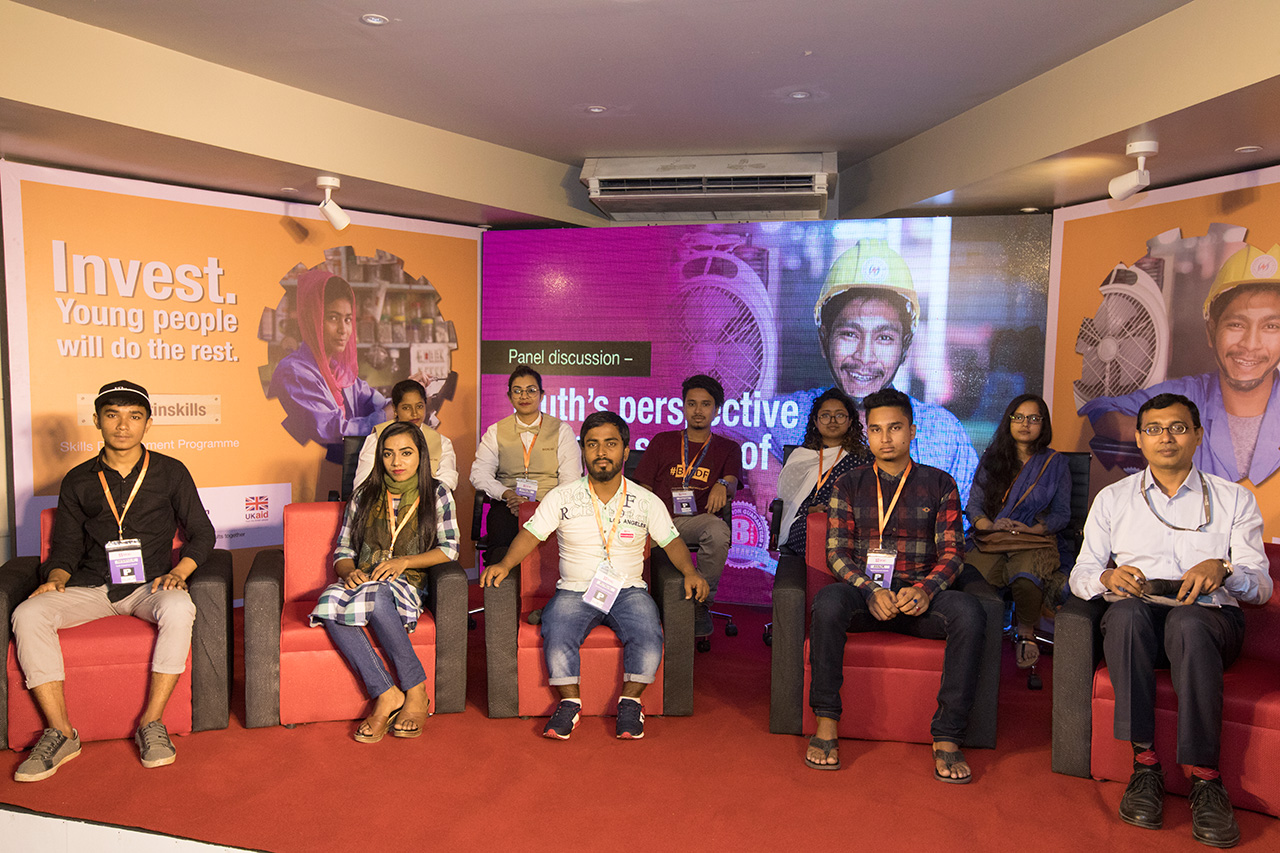
No less than 400 thousand youths, a large portion of which is women, received training in a number of employable skills in non-agriculture sector from BRAC in last eight years and have found decent employment or started own initiatives.

BRAC officials revealed this information at an event today on Tuesday (23 July 2019) at the BRAC Centre in Dhaka. BRAC organised this event as a part of its celebration of World Youth Skills Day. The programme comprised an exhibition of BRAC skills development initiatives, launch of a publication titled “Star Toolkit: Introducing a Successful Entrepreneurship” and a series of panel discussions.

Faruque Hossain, chairman, National Skills Development Authority, was present as the chief guest at the panel discussion titled “SDG-8: Youth, skills and employment”. Tapan Kumar Ghosh, chairman, Bureau of Non-formal Education, and KAM Morshed, director, BRAC, participated in the discussion among others. Asif Saleh, acting executive director, BRAC, moderated the discussion.

Angela Naumann, first secretary, Department of Foreign Affairs and Trade, Australian High Commission, Bangladesh, Mashfique Ibne Akbar, private sector development adviser, Department of International Development, British High Commission, Dhaka, Zhigang Li, social sector specialist, Asian Development Bank, Tomoo Hozomi, country representative, UNICEF Bangladesh, participated in another panel discussion on financing of skills development initiatives.

BRAC Skills Development Programme is currently working with focus on three areas, namely, skills training and other services, systems change with the government and industry partnerships, and community engagement. At present it is operating eight projects focusing on the communities living in the cities, municipalities and Rohingyas and host community in Cox’s Bazar. These current projects are: Skills training for advancing resources (STAR), Promoting skills and productivity enhancement for resilience (PROSPER), Promoting business Incubation for small entrepreneurs (PROMISE), Pro-poor growth of rural enter-prises through sustainable skills-development (PROGRESS), Alternative learning programme for out of school adolescents (ALP), Partnership reinforcement for integrated skills enhancement (PRISE), Skills development project for Rohingyas, and Apprenticeship-based training for host community.

BRAC’s Skill Development Programme began its activities with the STAR project, which has developed a unique model reforming and institutionalising the ancient tradition of skills training through apprenticeships under a master craftsman. Under STAR project, BRAC officials find out skilled people who run their own business. After they go through specially designed training, selected trainees start apprenticeships under them. The trainers receive an honorarium for running the six-monthly course. This model on one hand creates opportunity for underprivileged youths for quality skill training, while helps keep costs low compared with institution-based training. After finishing apprenticeships, BRAC assists the youths to get decent jobs or start their own business.

Under the STAR project, BRAC trained 30 thousand youths up to December 2018. Of them 95 per cent found decent employment. For women trainees the impact is even bigger, reducing child marriage 65 per cent. Post training, the apprentices saw six times increase in both income and employment.

BRAC developed this unique model jointly with ILO, UNICEF, Department of Non-Formal Education of Bangladesh government and follows the National Technical and Vocational Quality Framework (NTVQF).

The experts at the panel discussions stressed effective collaboration between the government, donors, non-governmental actors and private sector for expanding the opportunities for employable skills development. They said to achieve SDG targets there is no alternative for skill development.

BRAC established Skill Development Programme with a socio-economic background of an increasing youth population, large gap in employable skills and training, risky migration of unskilled and semi-skilled labour force, increasing violence against girls and women, and expansion of urban spaces and their population.

Targeting both the domestic and overseas labour market, BRAC is currently giving 15 kinds of skills training in non-agriculture sector, which are: Tailoring and dress making, mobile phone servicing, wooden furniture making, beauty salon, refrigeration and AC servicing, basic electronics, graphic design, IT support technician, aluminum fabrication, motorcycle servicing, wooden furniture designing, electrical house wiring, block and batik, screen printing, jori and chumki work.

Tuesday, December 31, 1974


Join in celebrating the 30 most productive collaborations 2020-1970 of women empowered sustainability generation goals 1 -5 and help log advances to 2025 Fazle Abed partners and 1billion girls mapped these 30 collaborations -six each for education , health, food/land, finance to end poverty, societal platforms for partners in 100% community (women as productive as men, young & old, colored & white
education opportunities <a href="https://www.catholicuni.com/search?q=4.1">4.1</a> adult skills 4.2 primary 4.3 teen 4.4 university 4.5 pre-school 4.6 multidisciplinary education luminaries health opportunities
3.1 oral rehydration 3.2 para health doordash basic medicines 3.3 scale vaccination 3.4 tuberculosis 4.5 Frugal processes eg wash sanitation, maternity; 3.6 James Grant School of public health food/land opportunities
2.1 rice 2.2 veggie 2.3 cash crops & village fair2.4 poultry 2.5 dairy, 2.6 14 nation leading supply chains financial opportunities to end poverty
1.1 change aid (sustainable charity), microfinance+, 1.3 ultra poor, 1.4 city bank 1.5 bkash, 1.6 hq2 brac intl netherlands
platforms for 100% lives matter community (women as productive as men , all skin cols equal opportunity etc)
5.1 100k person metavillage; 1 billion asian women, brac net, 5.4 100 asian universities share sdg graduates 5.5 climate smart village exchnagtes, 5.6 zoom me up scotty

Monday, February 9, 1970

 Join in celebrating the 30 most productive collaborations 2020-1970 of women empowered sustainability generation goals 1 -5 and help log advances to 2025 Fazle Abed partners and 1billion girls mapped these 30 collaborations -six each for education , health, food/land, finance to end poverty, societal platforms for partners in 100% community (women as productive as men, young & old, colored & white

education opportunities 4.1 adult skills; 4.2 primary; 4.3 teen ; 4.4 university; 4.5 pre-school ;4.6 multidisciplinary education luminaries health opportunities
3.1 oral rehydration 3.2 para health "doordash" basic medicines 3.3 scale vaccination 3.4 tuberculosis 3.5 Frugal processes eg wash sanitation, maternity; 3.6 James Grant School of public health food/land opportunities
2.1 rice 2.2 veggie 2.3 cash crops & village fair2.4 poultry 2.5 dairy, 2.6 14 nation leading supply chains financial opportunities to end poverty
1.1 change aid (sustainable charity), microfinance+, 1.3 ultra poor, 1.4 city bank 1.5 bkash, 1.6 hq2 brac intl netherlands
platforms for 100% lives matter community (women as productive as men , all skin cols equal opportunity etc)
5.1 100k person metavillage; 1 billion asian women, brac net, 5.4 100 asian universities share sdg graduates 5.5 climate smart village exchanges, 5.6 zoom me up scotty: adamsmith.app 2022: year 264 in search of moral market leadership

Friday, January 31, 2020

4.3 ela uganda

 1 from nextbillion   https://nextbillion.net/scale-government-girls-empowerment-program-public-school/

and 2 from mastercardfoundation


Charting a Pathway to Scale Through Government: Adapting a Girls’ Empowerment Program to a Public School Setting

Though women and girls face many gender-related challenges in countries around the world, these issues – from gender-based violence to unplanned pregnancies and child marriage – are often particularly acute in emerging economies. In response, many development organizations have utilized group-based programs to work against common risk factors and empower adolescent girls and young women – goals that have only become more important in light of COVID-19’s impact on this population.

For instance, BRAC’s Empowerment and Livelihood for Adolescents (ELA) program seeks to support vulnerable young women through a wide range of trainings that can be grouped under three pillars, including education, social empowerment and economic empowerment. Groups of about 30 girls meet several times a week with a near-peer mentor in ELA clubhouses, which are designed as physical safe spaces near girls’ homes. In these safe spaces, girls not only receive social and economic empowerment training but also have an opportunity to socialize in a safe environment, free of judgement or oppression.

BRAC’s ELA program has been implemented in several countries and rigorously evaluated in Uganda, Sierra Leone and South Sudan. These evaluations revealed that the presence of ELA clubs in villages can lead to decreases in teen pregnancy and increases in the likelihood of engaging in income-generating activities for participants. In cases where ELA was implemented during a crisis, including Ebola in Sierra Leone and civil war in South Sudan, the presence of the clubs helped offset many of the negative impacts of these crises among girls.


A SHIFT IN BRAC’S EMPOWERMENT AND LIVELIHOOD FOR ADOLESCENTS PROGRAM

The ELA program has been active since 2006, when the first clubs were launched in Uganda. But despite its longevity and impact, the program is currently undergoing a major shift. Although ELA had been successfully scaled up in multiple countries with positive results recorded in randomized controlled trials, we found that the curriculum had become outdated and was no longer meeting the needs of youth. Attendance in many places began to dwindle. To better address girls’ changing needs and interests, we redesigned the curriculum and launched a new pilot program, which has yielded positive results so far. The curriculum was segmented by age (10-14 and 15-22), and content was made more engaging and age-appropriate with youth mentors and staff input.

But the program has faced another key challenge: With neither a consistent long-term source of donor funding nor a viable path to self-sufficiency, it is difficult to sustain and scale over the long term. To address this issue, BRAC is now exploring alternative pathways to scale, including an intriguing new solution: adapting the ELA program to an after-school setting in Uganda, allowing it to be scaled through government schools.

Below, we’ll discuss how BRAC embraced this opportunity, how we assessed the viability of such a model, and what it might mean for the evolving ELA program and similar programs at other organizations. We will also discuss how we identified and addressed the potential issues that could arise when leveraging government involvement in such a program in pursuit of scale.


USING FORMATIVE RESEARCH TO INFORM PROGRAM ADAPTATION

We recognized that working in schools represented a sharp departure from the original ELA model. After all, ELA is a community-based program originally designed for out-of-school girls. By contrast, an after-school model would create safe spaces in schools, rather than community-based clubhouses, and engage teachers instead of near-peers to serve as mentors and lead club sessions. This would raise a number of issues, and we knew that adapting the ELA model to an after-school setting would be no easy task.

Furthermore, we had to ask: Would schools, teachers and Uganda’s Ministry of Education and Sports support this new model? We decided that rather than launching a pilot and jumping into an evaluation with assumptions that might not hold true, we should first take a step back and conduct much-needed formative research to answer these questions.

We believe that formative research – i.e., exploratory work typically done at the start of a new project – should be conducted anytime an existing program is adapted to a new context. Formative research can be conducted through a variety of strategies, including situation analysis and stakeholder analysis, and can utilize both qualitative and quantitative research methods. (For those unfamiliar with formative research, J-PAL’s guide to measuring women’s and girls’ empowerment provides a succinct primer on the role of this type of work in this subject area.)

After conducting extensive desk research, we developed a research plan that included focus group discussions with adolescent girls and young women and their parents, semi-structured interviews with school district officials and teachers, and key informant interviews with research and implementation experts focused on after-school programs or youth empowerment. In total, we interviewed 184 stakeholders. In addition, we formed an Advisory Committee consisting of experts, a Ugandan youth activist, and representatives from the Ministry of Education and Sports, and engaged in a learning exercise with the Asante Africa Foundation to learn directly from their design methods and successful work in schools.

From these activities, we learned that there is ample support for our ELA in Schools idea from various stakeholders, including the Ministry of Education and Sports. We also learned that teachers may need extra support to be effective mentors, both in their ability to facilitate club sessions and to form trust-based relationships with students. Furthermore, we realized – as one Advisory Committee member, Markus Goldstein of the World Bank’s Gender Innovation Lab, observed – that “just because someone can teach math, doesn’t mean they can teach life skills.”

Our formative research also revealed additional considerations, such as concerns from parents and caregivers, teachers, and girls themselves regarding girls’ safety in school. In addition, many stakeholders encouraged BRAC to engage adolescent boys and young men, both in the ELA in Schools project and in our overall youth programming as well. Overall, the research left us with important new topics to consider, compared to when we started. For a learning organization like BRAC, this gave us the opportunity to reflect on what we learned in order to stretch and grow in the right direction.


THE FUTURE OF THE EMPOWERMENT AND LIVELIHOOD FOR ADOLESCENTS IN SCHOOLS PROJECT 

We originally planned to conduct a pilot of the ELA in Schools project in 30 Ugandan schools. However, based on our findings, we realized that BRAC still has a lot to learn about planning for scale in a school setting. So we decided that we need more research before launching a larger pilot.

Currently, ELA in Schools is being prototyped in just eight schools in the Mubende and Mityana districts of Uganda. Much like during the formative stage of the ELA in Schools project, we are moving forward deliberatively, evaluating the process – and regularly consulting key stakeholders such as education experts, teachers, parents and caregivers, and girls along the way. To be sure, the program has encountered challenges, not least among them the closure of Ugandan schools in June 2021 due to a surge in COVID-19 cases. Despite these challenges, support within the formal education system remains strong. Teacher-mentors even requested that they be allowed to continue the club sessions despite schools not being open. With permission from education officials and adequate health and safety guidelines in place, such as masking and social distancing, they have been allowed to do that in small groups.

Formative research, by definition, is used to inform program implementation, so many of the insights we’ve generated are specific to the ELA project. With that said, time and context-specific findings can also be relevant to other organizations and researchers exploring similar topics and issues. As we continue to carry out our work to adapt ELA to school settings in Uganda, we hope that the findings of our research will prove useful for other organizations and enterprises in the youth economic empowerment space as they adapt, whether due to the pandemic or other circumstances, and explore viable pathways to scale.


The ELA in Schools project is being funded by the Bill & Melinda Gates Foundation.


Esau Tugume is a Research Associate at the BRAC Independent Evaluation and Research Cell (Kampala, Uganda) and Jenna Grzeslo is the Senior Program Manager, Research and Learning, at BRAC USA.

===============================================

https://mastercardfdn.org/how-education-reforms-can-transform-learning-and-leadership/

How Education Reforms Can Transform Learning and Leadership

After generations of outdated, rote curricula, new revisions and reforms to African education are transforming learning opportunities for the continent’s youth. Yet learners rarely gain exposure to the 21st century skills that help them secure employment and spur innovation, creating entrepreneurship opportunity for themselves and others along the way.

One way in which curricula can be developed to meet the needs of Africa’s young workforce is the inclusion of internships, developing connections to mentors and career guidance personnel, and provide avenues for innovation within teams, more opportunities for field work, capacity building and mindset change.

But there is reason to be optimistic. In partnership with 27 organizations, the Mastercard Foundation Scholars Program is ushering in a new style of exposure to learners. In Uganda, the Mastercard Foundation has partnered with BRAC Uganda to provide holistic support to the learners so that they can better understand themselves as young leaders with the potential to transform their communities.

Transformative Leadership and Giving Back

Never should one always be on the receiving end. One should also give. As Scholars, during secondary school holidays, we were introduced to community service workshops where the spirit of giving back and teamwork for social transformation was instilled in us. These workshops taught us that there is something we can all contribute to the betterment of humanity. That our basic and universal human quest is to find meaning in our lives.

To nurture this sense of commitment to others, BRAC Uganda has organized career guidance seminars. In one of the seminars, I recall one of the career guidance specialists telling us to ask ourselves these questions: Who am I? What is my purpose? What is my giftedness and what can I do with it? What am I capable of becoming and how can I actualise it? What do I want to spend my life doing? What career will help me realise my personal mission? How can I prepare myself for that career? What legacy do I want to leave behind? What value do I want to leave behind me? What path can I take?

These questions have helped many others like me to shape our lives because we were given an opportunity to understand ourselves better and what we can do with what we already have in terms of gifts and talents. It’s always important for each one of us to understand what we are good at.

The game of life is about making ends meet, pursuing a fulfilling career, achieving personal mission and purpose. That is what gives meaning to one’s life so that at the end of it all one can confidently say: this was a life worth living. I made a difference.  Indeed, I was born into this world for a noble purpose.  I won a victory for humanity. What a successful person I am.

BRAC Uganda also organises a leadership congress where Scholars connect with leaders in many different sectors, including entrepreneurs, motivational speakers, artists, health and education gurus. These people tell us real stories of how they’ve been able to build a successful life.

Building a Network of Change-makers

After graduating from high school, Scholars are inducted to an alumni network, which is a growing family of young brilliant minds ready to innovate. Their innovations are then pivoted to community development. We network with people from the Ministry of Education and the Mastercard Foundation who guide us on career choices. During this time, the Foundation introduces us to online platforms like Baobab, a closed social media platform where Scholars build community, connect with mentors, as well share views for social transformation and engaged internship opportunities.

These opportunities are amazing.

After our graduation from secondary school, BRAC Uganda alumni are placed in different organizations for internships to prepare them and develop their professionalism and work ethic before transitioning to university. I interned with Reproductive Health Uganda, where I was introduced to a working environment, networked and built my roster of contacts, completed a community-based reproductive health course, and worked on community assessments and outreaches.  This has given me an upper hand in my early career.

Innovation in Education

Despite these positive steps, more transformation of the educational sector is required. Governments, universities, and organizations which aim to support the education and professional development of students across Africa should think of how they can promote and kick-start the innovations of young people to help in job creation and community transformation.

It’s also paramount that education of citizens should also include entrepreneurship training so that youth can become drivers of job creation.  Teachers being at the front line of the education system should be equipped with the relevant skills demanded by the 21st century.

Youth who have graduated from Mastercard Foundation Scholars Program institutions are taking the lead to create powerful change in their communities, collaborating to shape ideas and later bring them to life. Innovations in our education has made us change-makers. By learning from our successes, we hope that other communities will have an opportunity to grow their skills and become the change-makers the entire continent deserves.

Kyomuhendo Bruhan is an alumni of the Scholars Program at BRAC Uganda.

Monday, December 31, 1973

old top section

from foundation in 1972 the values of abed/brac were Paulo Freire's (the brazilian who applied franciscan servant leadership to education - pedagogy of the oppressed)
abed was 34 when banglaadesh was born as a new nation and arguably Asia's leading young oil company engineer (regional ceo royal dutch shell); he cashed up his life savings and rebuilt over 15000 villagers one room homes (nearly 100000 people) that had been flattened by war; while oxfam who had given him a matched grant rated this the most effect ive relief project ever- abed was heartbroken with village mothers and infants dying in the village pathways every day of famine and dehydration; it occurred to him he was responsible for designing village businesses mothers could operate at a small profit while ending famine with eg rice production or ill health by distributing basic medicines - for 10 years the educational focus  was adult - what mothers needed to understand to operate  microfranchises; then additionally village mothers asked abed to build 4.2 the largest non-government primary schools ;by the early 1990s he was  designing teen girl-apprenticeships with libraries 4.3 and in 2001 he opened  4.4 brac university 


visit 100000 villagers at birth of nation Bangladesh
download one page tour to 50 years of building partners empowering Asian village women to end poverty, design last mile health service and much more- how brac became the ngo world's largest networking economy. 2022 NOW: innovate 5 last mile services for any space girls are born- safe homes, education, health, food, finance; in searching we found a billion village mothers wanting to COLLAB. ..video 1
visit 100000 VILLAGERS AT BIRTH NATION BANGLADESH...Download 2-page guide ..
.consider cases of new nations after world war 2- how many cases lived up to the peoples
 simplest dreams, end poverty, food/health/safety for every family member, education
geared to decent jobs and happiness? bangladesh did something different-
 empowering 90% of women to find partners in building their own communities-
.over 50 years a new economic model emerged which a billion asian women applied
to end extreme poverty- how?.


sustainability generation goal 5 100% livesmatter communitY 1 PLATFORMS 1 PLATFORMS 5.1 5.2 5.3 5.4 5.5 5.6; 4 livelihood edu for all 4.1 4.2 4.3 4.4 4.5 4.6 ref Safiqul Islam 3 last mile health services 3.1 3,2 3.3 3.4 3.5 3.6 last mile nutrition 2.1 2.2 2.3 2.4 2.5 2,6 banking for all workers 1.1 1.2 1.3 1.4 1.5 1.6 .
..
examples from abed builder of largest ngo partnership: Reeta Roy MCF 3.3 1billion$ to vaccinate continent africa 4.3 uganda; Soros 1.1-1.6 ineteconomics bottom-up, 4.4 new university OSUN 3.4 end TB; Gates 1.1-1.6 digital finance; 2.1-2.6 extending mpesa in tanzania's green revolution; world bank 1.3 first 100 ultra poor nations co-researchers, 4,4 first 100 nations early childhood play co-researchers
in contrast tu unicorns, we define hunicorns as billion dollar startup networks to valuable to human life for exiting investors or quarrelsome political parties -hall of fame first 1000 hunicorn collabs with sir fazle abed

nspired by franciscan values) helped billion asian mothers do this over 50 years - join most exciting action learning networks and lets map AI algorithms = optimal livesmatter community builders -2021 join in glasgow cop26 & dubai rewired greatest youth meetings ever with thanks to abed.games youthmarkets.com & worldrecordjobs.com
xx

Which 30 educational and economic partnerships most empower a billion women to end extreme poverty, and value their children’s sustainability? Fortunately for those caring about sustainability 2020s, we can map this by around partners and alumni of 50 years of servant leadership by fazle abed 1970-2019 together with legacy specifications mapped through his final decade

Viewed from 1970, Increasing life expectancy from 25 years below to average helped gravitate development economics world’s most trusted partnership – hence sustainability last mile service markets

3) last mile health
2) agriculture for village food security


4)non-linear livelihood education
5) timing what platforms partners could facilitate entrepreneurial revolution not not just inclusive community but cooperation in full and meaningful entrepreneurial employment

financial entreprenurial revolution for nation's people history excluded from machine age


Friday, November 30, 2018

4.3 5.6 new report on skills teens up need to work in 2020a

 report here  https://gbc-education.org/wp-content/uploads/2018/11/Deloitte_Preparing-tomorrows-workforce-for-4IR-revised-08.11.pdf

it claims these priorities for businesses to prepare work in 4th industrial revolution

This report was published by Deloitte Global and the Global Business Coalition for Education.

whilst not everyone agrees on borders as biographers of von neumann 


we have argued youth and communities get left out without

IR 1 access power/energy of engines ir1

IR 2communications/telecoms/ satellite access/tv /radio of engines

to alumni of Adam Smith it is how clear that IR1,2 had to be but reality is by world war 2 apps of IR1, IR2 wwere mainly zero sum at best "the mercantile colonial era" in which probably less than 15% of peoples extracted rom rest of world's humans 


humans need above zero sum applications of engines both to end poverty of those previously excluded from engines and if post world war2 tech systems were not to compound another extinction-bordering mess ; note for example apps which share life critical knowhow multiply value in use unlike consuming up things; this is teh context through which our biography values see neumann's purpose in fathering modern cering digital tech


we define IR3 as era of designing sustainable community win-wins with what by moores law has compounded to be a trillion times more digital tech than needed for moon race


in our view ir4 is most usefully though of as range of autonomous systems that take over from humans governing real time ops data because there is too much streaming in contextually from every gps for anything other than tech to connect in real time


see also our 40 year countdown 2025report.com started as book with the economist in 1984 exponentially counting down investment - will millennials be the sustainability gen?


Monday, July 12, 2021

six dimensional education "squared" for nation building and 1 billion women sustain our species!

 which of these dimensions interest you most?

4.1 adult-lifelong edu- this is where billion womens empowerment began in 1972- why women and infants were literally starving to death in villages- so almost everyone fazle abed hired for a skill a village woman could make a business put of - eg growing rice, tending for 6 families infants while other village mothers worked on agriculture, learning oral rehydration; ; some adults started asking could they train to be teachers of kids 6-10

4.2  classrooms with one village and 25 kids aged 6-11 took off in mid 1980s - 30000 skills were franchised- hapines, confidence, peer to peer montessori style was the culture

4.3 resources for designing edu for teens were much more constrined- what took off was peer to peer apprentice spaces for particular skills as well as scholarships for those who made the most of primary; the whole area of non-classroom secondary matters everywhere that there is a livelihood mismatch- for 15 yeqrs now we have estimated the world is short of nearly 100 million last mile health workers- covid may have shown thats an under-estimate; secondary girls apprentice clubs have proved particularly successful in clarifying what skiils teens most want; finding enough trainers has been relatively simple for brac in bangladesh since most brac co-workers recruited as trainers in villages- 

5.3 brac internet from 1996 was the first time brac could search for 2.0 partners - previously there was no point hiring trainers / attracting investors unless solutions worked in villages without electricity-now brac had both second Generation To support eg village daughters moving to cities as well as possibility of experimenting with solar and mobile in villages- the need was for brac university - now brac could offer deep learning: village research and connect university research around the world with 4.4 new uni (squared now alumni of abed could blend the 6 age groups of traditional real education with anything digitall connections with mother earth's urgent climate etc demands can offer

4.5 what new to the world masters of arts do you think abed chose first? early childhood education - can you think of reasons he valued this global innovation in addition to it being the one age group brac hadn't educationally served?

4.6 abed asked for his legacy to be a luminaries network- each luminary to bring a different piece of the jigsaw education is everything in developing peoples and nations


Monday, May 31, 2021

4.3 why sustainability may yet depend on how we spend youths time from 11+ 4.4

abed-japan embassy debrief 2012 quite frankly millennial goals up to 2015 overemphasised primaryaid  to exclusion of livelihoods and teens needs - as early as mid 1990s we were forced into being the world's beyond the classroom teens girls metalab but that may not be a bad thing- pretty much every community livelihood girls can own now has peer to peer mentoring clubs somewhere across brac international 12 countries -hi touch networking

37th annual update 2025report.com on education determines sustainability

===============if we are to leap forward in 21-22 we must get tech right for teens starting with women in most desperately challenged livesmatter communities

asia is discussing this through alumni and zoom summits of www.educommissionasia.org which starts 6 months of asia leading world change in education - see december's triple reports of the year - yidan hong kong; wise qatar;   rewired2021.com dubai and un and uae expo relay with japan

if there is anywhere that might change beyond classroom in usa try moving along with  czi 

==================

 why did all 4 industrial revolutions devalue what sdg teens needed most?

the british empire system was designed to examine out 99% of youth as fast as possible- to adminster the empire you needed to be of one mindset intellectuslly- anyone whose talents could have been pracxtica - eg artistic was the first to be examined out; 

although flow studies of maximising human potential eg csik recomment maximising time each person spebds at the experiemtial edge of the most unique skill- few western edu systems permit that- in usa you getexamined or you become a top sports star or your on the streets

compare this with nordica langiage of we hsave no bad schools, no standard exams, no homework- all our communities are safe energetic places for teens to engage their afternoons in ...

when you look to abed alumni contributions to 11-17 education- you do have to look practice by practice; until 2015 millennium goal aid focused only on primary schols getting every child in one - so in the developing world, secondary funding is extremely scarce

the fact that this forces skill by skill investments - eg coding schools for teenage girls, oeer to peer adolescent girls health training, girls small enterprise clubs in ten skills women provide to women from haircutting to garment design may not be a bad thing but you certainly need to look specifically for whos inspired who for abed 4.3

====================================

when it comes to white empire history of not valuing most teens you might want to check out my fathers 1986 survey in the economist which rewinds back to the start of adam smith's industrial revolution and appraisal of what oxford's purpose was in selecting which teens it neded and what it would do to them


ppt download


this survey is dad's more detailed follow up to the 1984 book i co-authored - the 2025 report- why transforming education will determine extinction or sustainability- and why deadline exponentials will reveal last chances through 2020s


Saturday, November 30, 2019

4.2 4.3 lifelong mentors: teaching and studying -barefoot teachers


http://blog.brac.net/educating-a-generation-bangladeshs-barefoot-educators/

 Rubia teaches 25 children with neurodevelopmental disabilities who would otherwise have no access to special education. She went through comprehensive training on how to work with children with neurodevelopmental disabilities

“I have never stop learning as a teacher,” says Rubia Akhter, “I recently received vocational training so that I can help my students with their crafts, which helps to improve their sensory and motor skills.”

Rubia started teaching in 2003 in one of BRAC’s primary schools. She had no formal qualifications.

Now in 2019, more than 12 million children have graduated from BRAC’s pre-primary and primary schools because of women like Rubia.

How did thousands of women like Rubia, in the most rural, remote parts of Bangladesh, who previously had little to no education, educate almost 13 million children?

Our approach was unconventional, but effective. BRAC has always been a catalyst, creating platforms for people to realise their potential. We believe people, no matter who or where they are, are powerful agents of change – even without the formal qualifications they never had the opportunity to attain.

These local women who became teachers, and leaders in their villages, were no different.

Now, in 2019, the landscape of education in Bangladesh has changed significantly. The government has ensured access to education, with a public school in almost every village in the country. The way BRAC delivered learning has also changed, with newer kinds of schools and centres, interactive digital material, and focus on 21st century skills.

What still remains true to the core of BRAC’s education programme is the idea that teachers serve as leaders – leaders who inspire and engage their students with courage and creativity, rather than making them simply comply.

Leadership is at the core of who our teachers are. Our leaders had to be confident, creative, and constantly learning. This requires rigorous training and continuous assessment. 

It begins with a two-week training before she begins her classes. Over the course of a four-year-long academic cycle, she receives 140 days worth of monthly refresher trainings. These include capacity training to help them prepare and plan for their regular activities and lessons, identify gaps and assess themselves. Dummy classes are also held by the programme’s staff. They discuss what more they need to learn and plan for their subject-based training, which covers a range of topics, and covers the most burning contemporary issues, such as climate change and values education. Continual assessments are based on the teacher’s subject knowledge and values, depending on how they plan and apply their day-to-day lesson plans. How they maintain discipline in their work, engage and interact with students with sensitivity and care, and their ability for storytelling are key areas of work for their assessment.

“It’s not enough that you have learned something today. Share your knowledge with the world. Tell your siblings and parents. Tell your friends who cannot come to school,” Hasne Mahbuba Munni tells her class.

In a country where more than half of girls are married before their 18th birthday, Munni fought to take control of her life. Her conservative brothers wanted her to marry at an early age. Munni went on to stop three early marriages as a member of BRAC’s adolescent clubs. She has come a long way from being a student in BRAC’s one-classroom school to being the headteacher of Shishu Niketan, one of BRAC’s multi-classroom schools in Rangpur, northern Bangladesh.

“I want every girl in my class to believe that she can achieve everything she wants.”

“I fled to Bangladesh with nothing, but I had an education,” said Rojina Bibi, “I have been luckier than most. I may not have a home anymore, but I know my education can help make a difference. I want my students to know they can too.”

Rojina is one of more than 700 Rohingya teachers who are helping teach more than 58,000 children in the refugee camps of Cox’s Bazar. She teaches in Burmese while another teacher, recruited from the host community, teaches in English.

Of the million Rohingyas who fled to Bangladesh, more than half were women and children. Rohingya women were the first to step forward to help others. BRAC responded to the crisis, with women at the centre of our humanitarian work- from going door-to-door with life-saving messages, to ensuring safe spaces where children can learn and play.

The world needs 69 million new teachers to achieve the global goals in education by 2030. We must recognise and empower people who are passionate and driven to educate. Our hope is that all children have teachers that ensure both their childhood and their future.


Dr Safiqul Islam is the director of BRAC Education Programme and Zaian F Chowdhury is the communications porfolio lead of learning, empowerment and innovation of  BRAC Communications.
