AT CU.com please find my attempt to celebrate my greatest personal privilege: to visit women empowered Bangladesh 15 times from 2007 during last 13 years of life of Fazle Abed. From 2012 we discussed AbedMOOC and 2015 onwards at his 80th birthday AbedAI. Back in 2001, Abed 65th birthday hosted by Steve Jobs in Silicon Valley changed both of these human genii's life work.
Before AI lifted off in late 2000s 3 underacknowlefgen Jappenings: 1 steve jobs hosted Fazle Abed's 65 th birthday party silicon valley 2001; .jensen hunag and steve jobs went from coding binary to cosinf pixels; Fazle abed clarified that paulo freire culture celebrated poorest asian womens ebd poverty networking miracle -- largest NGO, providing education, health services, microcredit and livelihood creation programmes for a significant part of the population of Bangladesh. What lies behind this huge success, Caroline Hartnell asked Fazle Abed, founder of BRAC and still very much at the helm. Questioning everything they do and being prepared to tackle whatever is needed to make their programmes successful are certainly part of the secret behind the success of this extraordinarily entrepreneurial organization.
The secret of success?
Asked what lies behind BRAC’s phenomenal success, the first thing Fazle Abed mentions is determination: ‘We were determined to bring about changes in the lives of poor people.’ The second thing is thinking in national terms: ‘We always had a national goal; we never thought in terms of working in a small area. We thought, all right, if we work with the poorest people in this community, who’s going to work with the poorest people in that other community? So we felt that whatever we do, we should try and replicate it throughout the nation if we can.’
The third thing he mentions is inspiration. ‘We always thought nationally, worked locally, and looked for inspiration globally. We were inspired by Paolo Freire’s work on the pedagogy of the oppressed, which he came out with in 1972. It was wonderful to have a thinker who was thinking about poor people and how they can become actors in history and not just passive recipients of other people’s aid. He made us realize that poor people are human beings and can do things for themselves, and it’s our duty to empower them so they can analyse their own situation, see how exploitation works in society, and see what they need to do to escape these exploitative processes.’
Finally, he says, ‘one needs to have not only ambition but also the ability to do the work. The organization must be competent to take on national tasks. That confidence we got from the campaign for oral rehydration, to cut down diarrhoeal mortality, in the 1980s. That involved going to every household in rural Bangladesh, 13 million households, and it took ten years to do it. Then we became a little more ambitious. We thought that if we can go to every household, then we can cover the whole country with everything we do.
...AP July 2025 - INTELLIGENCE ENGINEERING'S ALPHABET : World Class Biobrains: Drew Endy, Matt Scullin, Daniel Swiger++- BI BioIntelligence, the most collaborative human challenge Mother Earth has ever staged?
NB any errors below are mine alone chris.macrae@yahoo.co.uk but mathematically we are in a time when order of magnitude ignorance can sink any nation however big. Pretrain to question everything as earth's data is reality's judge
Its time to stop blaming 2/3 of humans who are Asian for their consciously open minds and love of education.
Do Atlantic people's old populations still trust and celebrate capability of generating healthy innovative brains? What's clear to anyove visting Washington DC or Brussels is a dismal mismatch exists between the gamechanging future opportunities listed below and how freedom of next generation learning has got muddled by how old male-dominated generations waste money on adevrtising and bossing. Consider the clarity of Stanford's Drew Endy's Strange Competition 1 2: Up to “60% of the physical inputs to the global economy”7 could be made via biotechnology by
mid-century, generating ~$30 trillion annually in mostly-new economic activity.
8 Emerging
product categories include consumer biologics (e.g., bioluminescent petunias,9 purple tomatoes,10
and hangover probiotics11
), military hard power (e.g., brewing energetics12
), mycological
manufacturing (e.g., mushroom ‘leather’
13
), and biotechnology for technology (e.g., DNA for
archival data storage14
). Accessing future product categories will depend on unlocking biology as
a general purpose technology15
(e.g., growing computers16
), deploying pervasive and embedded
biotechnologies within, on, and around us (e.g. smart blood,17 skin vaccines,18 and surveillance
mucus19
), and life-beyond lineage (e.g., biosecurity at birth,20 species de-extinction21
).
Natural living systems operate and
manufacture materials with atomic precision on a planetary scale, powered by ~130 terawatts of
energy self-harvested via photosynthesis
Biotechnology enables people to change biology. Domestication and breeding of plants and
animals for food, service, and companionship began millennia ago. Gene editing, from
recombinant DNA to CRISPR, is used to make medicines and foods, and is itself half-a-century
old. Synthetic biology is working to routinize composition of bioengineered systems of
ever-greater complexity
AIH- May 2025.Billion Asian womens end poverty networking 2006-1976 is most exciting case of Entrepreneurial Revolution (survey Xmas 1976 Economist by dad Norman Macrae & Romano Prodi). In 2007, dad sampled 2000 copies of Dr Yunus Social Business Book: and I started 15 trips to Bangladesh to 2018- many with apprentice journalists. This is a log of what we found - deepened after dad's death in 2010 by 2 kind remembrance parties hoist by Japan Embassy in Dhaka with those in middle of digital support of what happened next. We witnessed a lot of conflicts - i can try and answer question chris.macrae@yahoo.co.uk or see AI20s updates at http://povertymuseums.blogspot.com. I live in DC region but see myself as a Diaspoira Scot. Much of dad's libraries we transfreered with Dr Yunus to Glasgow University and enditirs og journals of social business, new economics and innovators of Grameen's virtual free nursing school. Bangladesh offers best intelligence we have seen for sdgs 5 through 1 up to 2008, Search eg
4 1 oldest edu 4.6 newest edu
; .620th century intelligence - ending poverty of half world without electricity -although Keynes 1936 (last chapter General Theiory: Money, Interest, Employment) asked Economists to take hippocratic oath as the profession that ended extreme poverty, most economists have done the opposite. What's not understandable is how educators failed to catalogue the lessons of the handful who bottom-up empowered villages to collaboratively end poverty. There are mainly 2 inteligences to understand- Borlaug on food science -arguable the forst Biointeligence rising ar1950 on; fazle abed on everything that raised life expectancy in tropical village (zero-electricity) asia from low 40s to 60s (about 7 below norm of living with electricity and telecomes). Between 1972 and late 1990s, Abed's lessons catalogued in this mooc had largely built the nation of Bangladesh and been replicated with help of Unicef's James Grant acroo most tropical asian areas. What's exciting is the valley's mr ad mrs steve jobs invted Fazle Abed to share inteligences 2001 at his 65th birthday party. The Jobs and frineds promised to integrate abed's inteligence into neighborhod university stanfrd which in any event wanted Jobs next great leap the iphone. The Valley told abed to start a university so that women graduates from poor and rich nations could blend inteligence as Abed's bottom of the pyramid vilage began their journey of leapfrog modles now that grid infrastructures were ni longer needed for sdiar and mobile. Abed could also help redesign the millennium goals which were being greenwashed into a shared worldwide system coding frame by 2016. There at Abed's 80th birtday party , the easy bit was checking this mooc was uptodate. The hard bit - what did Abed mean by his wish to headhunt a Taiwanese American to head the university's 3rd decade starting 2020?
Even before the pandemic reversed progress in reducing extreme poverty, policies and programs largely failed to meet the needs of the poorest and most marginalized. Unless that failure is corrected, the most severe forms of poverty will remain entrenched long after the COVID-19 crisis ends.
DHAKA – From 1990 to 2019, the number of people living in extreme poverty (according to the World Bank threshold of $1.90 per day) plummeted, from 1.9 billion to 648 million. COVID-19 has reversed much of this progress. By the end of 2021, the pandemic will have pushed approximately 150 million people back into extreme poverty.
Even before COVID-19, however, the world was not on track to end extreme poverty in the next decade. Progress on poverty reduction had been slowing long before the pandemic hit, with global poverty rates falling by less than half a percentage point per year between 2015 and 2019. At that pace, even without COVID-19, 537 million people would have still been living in extreme poverty in 2030, implying failure to meet the United Nations Sustainable Development Goals, in particular SDG 1.
At BRAC, the world’s largest Global South-led NGO, decades of designing, implementing, advising on, and adapting poverty reduction interventions have given us insights into how to make anti-poverty programs and policies more effective.
First, programs need to reach people in the most extreme states of poverty. People living in extreme poverty face hurdles to accessing social programs and services. They are less likely to have bank accounts, permanent addresses, or formal identification – all of which may be required for registration. They also face social stigma associated with receiving public services, and often lack sufficient information about the programs for which they are eligible.
In low-income countries, 79% of the bottom quintile of earners receive no social assistance whatsoever. To ensure that help reaches those most in need, governments and their partners must design policies and programs that overcome the barriers people living in extreme poverty face and integrate them into existing social safety nets.
Second, programs must empower people living in extreme poverty to build long-term resilience. Governments and their partners must do more than improve the provision of basic needs. They must also invest in enabling people in extreme poverty to acquire the skills and resources they need to avoid falling back into the poverty trap. This approach is crucial in times of crisis, as our team at BRAC found when advising the Philippine government, in partnership with the Asian Development Bank, on a recent anti-poverty intervention.
Subscribe to Project Syndicate
Enjoy unlimited access to the ideas and opinions of the world’s leading thinkers, including weekly long reads, book reviews, topical collections, and interviews; The Year Ahead annual print magazine; the complete PS archive; and more – for less than $9 a month.
SUBSCRIBE NOW
During the pandemic, the program connected participants to cash assistance from the national government and food assistance from their local government. Meanwhile, it provided the resources and training they needed to establish multiple sources of income. As a result, 76% of participants were able to continue earning income even during strict lockdowns.
Third, programs need to treat poverty as multifaceted and context-specific. Extreme poverty is multidimensional. An accurate definition must account for the many areas of deprivation people living in extreme poverty face, from lack of clean water and electricity to malnutrition and social exclusion. These deprivations and the interventions needed to overcome them vary across populations and geographies. Based on an assessment of factors related to specific locations and socioeconomic contexts, governments and their partners need to create more holistic interventions that empower poor people to face their unique challenges.
Fourth, these programs must engage local communities and governments, whose active participation can help anti-poverty interventions better reflect the realities of people’s daily lives and gain local buy-in. Bringing civil society into the process can also play an important role in holding government accountable and sustaining demand for more effective programs and policies. And local governments can help national governments and their partners identify marginalized households and support their social inclusion.
Fifth, governments and their partners must learn what is working and what is not, then adapt programming accordingly. To maximize the impact of anti-poverty interventions at scale, governments and their partners must commit to monitoring, evaluating, and learning from programs as they are implemented, then revise them as needed.
Such evaluations should begin by identifying the principles driving programs’ design. Program components must then be tweaked and tested with those principles in mind, and the outcomes carefully monitored. Only through evidence-based adaptation can governments and their partners ensure that the programs they implement have a long-lasting impact and adjust to meet the unique and evolving needs of their people.
This must be a collaborative effort. If the international community adopts these steps, anti-poverty programs and policies can become more inclusive, adaptive, and comprehensive. Beyond engaging civil society and academia, governments need development actors, including multilateral institutions and donor countries, to help close resource gaps until they can independently mobilize sufficient domestic resources. Many low- and middle-income countries simply lack the fiscal space and state capacity to pursue large-scale poverty reduction measures on their own.
SDG 1 is deeply connected to the other SDGs, from ensuring gender equality to advancing sustainability to improving nutrition. COVID-19 has reversed decades of progress in these areas, and we need cross-cutting interventions that support multiple areas of development simultaneously if we are to recover. The only way to prevent leaving many people behind is to ensure that anti-poverty interventions are better funded, more holistic, and more effective at scale.
SDgoal 2 food wash dc 12 - main UN operational branches rome - wfp, ifad
highlights from transcript, Fazle Abed, video oct 2016
I have
worked on poverty alleviation over the last 40 years in Bangladesh and when catherine
used to be the head
World Food Program we worked on a program called vulnerable group development
program working
with the poorest 10% of bangladesh's population providing support through food
rations for two years but
then we found that most of these people who received the food rations didn't
really improve themselves to a level where they could come out of poverty
02:57 So in Bangladesh
we started a differently designed program in 2001 called targeting the ultra
poor 1.3 -again the poorest ten per cent) but this time we provided support in terms
of an asset transfer -perhaps 3 goats --we
also provided them training/ hand-holding and we gave them a stipend for their
children to go to school
-mainly
women headed households in Bangladesh; so we aimed to graduate them out of extreme
poverty to a level of poverty where they can access market-based solutions eg by becoming a microfinance borrower and over
the years we have now graduated about 1.5
million families in Bangladesh
Back in
2005 a delegation from CGAP consultative , part of the world bank's ultra poor
team came to Bangladesh- they looked at our program and said why don't we
replicate this program in other countries
so Ford Foundation and CGAP funded a program in 10 countries three in
Asia including India Pakistan and then Ethiopia Ghana Liberia then haiti honduras and
peru
so
these countries were pilot projects modeled on the bangladesh/brac program and
there were three research institutions the MIT poverty action lab, the Dean Karlan at Yale School of Management
and also London School of Economics they were hired to monitor the progress on
these ten
projects
this
involved randomized control trials so what
we are hoping is that if this is the way to graduate very poorest of the poor
people
various
governments and donor agencies will take this up
07:34
the
first country that is now interested in scaling up a large is the Kenyan
government with
the help of funding and implememtation by CARE and one other agency
which brac will offer tech support to- this will be the first major project outside
Bangladesh
and I'
talked yesterday to the president of World Bank, jim kim, trying to get him to visit
brac program
in
Bangladesh when he goes there in a couple of weeks from now and hopefully also
to
try
and support if he's convinced , application in other countries 08:28
so we have found one way of tackling extreme poverty and hunger in Bangladesh; the point about this particular program is
that is the poor themselves who do all the hard work to get themselves out of
poverty so
All we have donei is create the enabling condition for them
=======================================
Accelerating Progress in Ending Hunger and Undernutrition
Kathy Spahn, President and CEO, Helen Keller International (Video)
Moderator: Catherine Bertini, Professor of Public Administration and International Affairs, Maxwell School of Citizenship and Public Affairs, Syracuse University
Hunger and undernutrition persist as major global challenges, yet some countries have proven successful at rapidly reducing both. For example, Compact2025 focal countries—Bangladesh, Ethiopia, Malawi, and Rwanda—have each reduced the prevalence of hunger by roughly half from 1990 to 2015. In Peru, hunger rates fell by even more than half, from 32 percent to just 7.5 percent in the same period. Some countries have also made great strides to reduce undernutrition. Bangladesh reduced child stunting rates by 1.3 percent annually from 1997 to 2007—and then made accelerated reductions from 2011 to 2014 when stunting rates fell from 41 to 36 percent. Successes like these show that rapid progress is possible. How to sustain progress in these countries and accelerate progress in others are key questions that will be addressed in this special event convened by Compact2025.
50 Years of Combating Extreme Poverty, From Bangladesh to the World
March 17, 2022 • 8 minute read
By Isabel Whisson | Senior Manager, Strategy and Max Gollin | Deputy Manager of Communications, BRAC Ultra-Poor Graduation Initiative
This year, BRAC celebrates its 50th anniversary and the 20th anniversary of its flagship Graduation approach. In 1972, Sir Fazle Hasan Abed KCMG (affectionately known at BRAC as ‘Abed bhai’) started BRAC as a small relief program, in the aftermath of the devastating Bhola cyclone and Bangladesh’s hard-won war for independence. 30 years later, BRAC pioneered the first Graduation program. Fast forward to 2022 and BRAC has directly empowered more than 2.1 million households to escape extreme poverty in Bangladesh alone via the Graduation approach and directly implemented or advised on Graduation programs in 15 additional countries. Nearly 92 million people across 75 countries have been reached by 219 economic inclusion programs which share elements of BRAC’s Graduation approach.
Reflecting on this history, our approach to extreme poverty eradication has been guided by four critical principles which underpin BRAC’s past success and future ambitions.
Put the furthest behind first
From the first village Abed bhai and his passionate team of volunteers began working with in 1972, BRAC worked from a philosophy of harnessing the innate power, agency and dignity of people, in spite of the vulnerability of their situation. He quickly realized he had to start with the most deprived areas and reach the people in the deepest forms of poverty first. This was more than a duty to serve the most vulnerable. It was the understanding that people living in extreme poverty were being overlooked in spite of their potential to lift themselves from their circumstances if only given the tools and self-belief that others had, to realize their potential.
According to Abed bhai, BRAC sought to embody Paulo Freire’s philosophy that people should be the subject, not the object of development programs. This principle lives on in BRAC’s work with governments today whereby we are demonstrating the power and potential of populations in extreme poverty that have been left behind by traditional economic development policies and practices. People living in extreme poverty must not be considered passive recipients of aid but powerful potential agents of change and progress. This principle continues to drive BRAC’s direct implementation, technical assistance, and advocacy around the Graduation approach.
Extreme poverty is multidimensional and requires a multidimensional approach
BRAC recognized that enabling people to escape extreme poverty would require a holistic approach that includes both social and economic empowerment. In 2006, reflecting on BRAC’s Graduation program in Bangladesh, Abed bhai wrote that, ‘the constraints [people] face in escaping extreme poverty are interlocked in ways that are different from those who are moderately poor. This challenges us to rethink our existing development strategies and interventions for the extreme poor, and come up with better ones that work for them.’ This was the challenge that drove BRAC to initiate what was an experimental programme in 2002, with the idea being ‘to address the constraints that the extreme poor face in asset building, in improving their health, in educating their children, in getting their voices heard, in a comprehensive manner so that they too can aspire, plan, and inch their way out of poverty.’
Evaluate and re-evaluate methods and assumptions
To ensure its programs had lasting impact, BRAC committed itself to a culture of critical self-evaluation, built on humility, curiosity, and rigor. These values led to the uncomfortable realization in the late 1990s that our programs were failing to adequately reach and generate long-term impacts for a subset of households living in the most extreme states of poverty and marginalization, which BRAC dubbed ‘ultra-poverty’. Graduation emerged from BRAC’s findings that its Income Generation for Vulnerable Group Development (IGVGD) program with UN World Food Program (WFP) and the Government of Bangladesh was having positive impacts, but women in ultra-poverty were still unable to access loans by the end of the program and needed more intensive support.
BRAC developed the Graduation approach in response to this need, constantly asking how it could improve the program, and if the assumptions it operated under remained valid. This constant, careful fine-tuning of the program led to significant and sustained impacts captured in randomized controlled trials, and sparking a tide of Graduation adaptations around the world. Even so, sensing that the program was no longer sufficiently suited to the evolving poverty context of Bangladesh in 2016, the Ultra-Poor Graduation (UPG) program probed nearly every aspect of Graduation in a major redesign. For instance, upon realizing its asset transfers were no longer large or diverse enough in the current market, the UPG program doubled their value and expanded the livelihood options available to participants.
Such reevaluations of Graduation have ensured its continued relevance and impact. They would not have been possible without BRAC’s commitment to rigor and connection to the communities we serve. BRAC takes firsthand insights from the field staff and listens to local communities, combining this lived experience with rigorous research through internal evaluations, working with the BRAC Institute of Governance & Development (BIGD), and external research partnerships to ensure program quality.
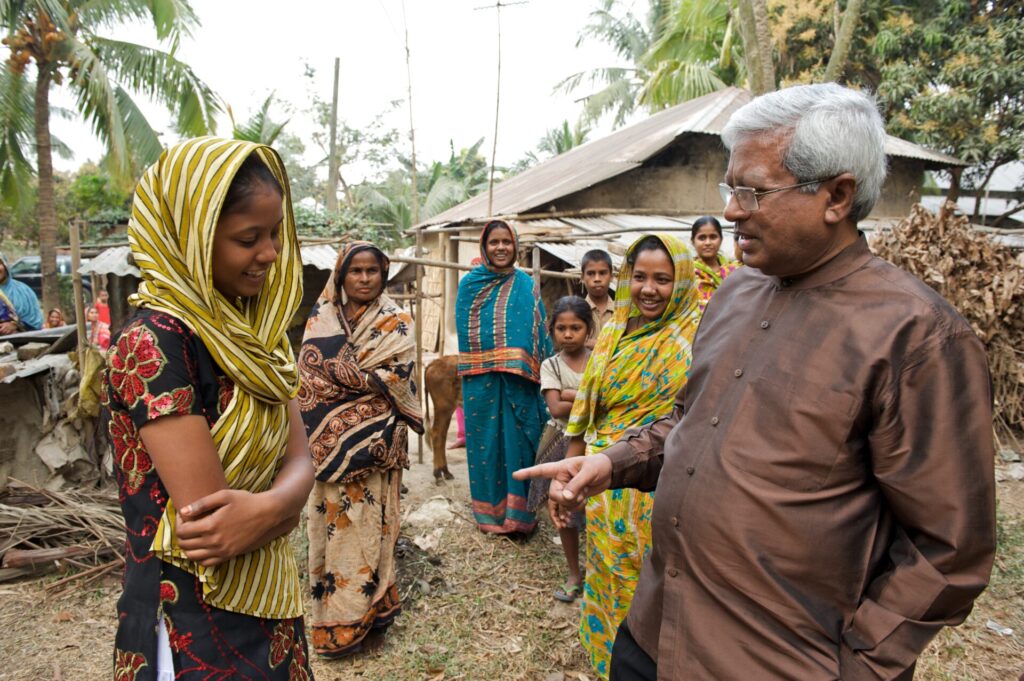
Abed bhai visits participants in a BRAC Microfinance Village Organization (VO) group in a village in Savar Thana, Bangladesh (2009).
Scale is paramount
The qualities listed above would have been sufficient to empower many people to improve their lives through Graduation. But Abed bhai’s vision, and the vision of his successors has always pushed BRAC to think of impact and scale as inseparable. As he often said, “Small is beautiful, but scale is necessary.” Impact at scale is an operating principle for BRAC.
A program is not sufficiently impactful because it can be effective for any one household, but because it has the potential to reach millions of households. This is what BRAC Ultra-Poor Graduation Initiative now aims to do as part of BRAC International’s efforts to bring an approach born in Bangladesh to the world for extreme poverty eradication. Programs we directly implement like UPG are BRAC’s soul and strength, where our experience, skills, and learnings come from, but we know BRAC – nor any other NGO – cannot achieve our vision for the world alone. Scale is only possible through ambition and collaboration.
By 2026, we aim to reach 4.6 million more households with the Graduation approach by scaling through government uptake with multisectoral partners. Sir Abed’s vision was for BRAC to reach a point where it was no longer needed. At the community level, this meant empowering people to continuously develop and improve their lives long after participating in a BRAC program. At a global scale, this means taking 20 years of experience with Graduation and passing that knowledge to governments, researchers, multilateral institutions, media, and civil society to continue expanding the approach.
With nearly 700 million people still living in extreme poverty globally, we face what may seem an insurmountable challenge. But by committing to the same values which have defined BRAC’s approach to extreme poverty reduction, the international community has the chance to deliver real, meaningful progress toward a world where the deepest forms of poverty are extinct.
“Poverty eradication may be a few years away, but it is possible,” said Shameran Abed, Executive Director of BRAC International, who oversees BRAC’s Graduation programs. “We should be the last generation on earth that sees extreme poverty. The resources are there. The research exists. It’s going to take some convincing of governments. It’s going to take some political will, which requires effective advocacy and technical assistance at the local level, but it can be done.”
1972 being an engineer abed spent his life savings building homes for 100000 villagers 5.1 only to find village mothers first question - what education/livelihoods do we need to end starvation> - dozens of mothers/daughters died weekly in abed's meta vilage until he (and partners) designed microfranchise solutions starting with rice 2.1 and last mile health services oral rehydration 3.1 and doordash (300 homes weekly per micrfranchise) 3.2
updates student year 21-22 sept which nations in asia most desperately need food solutions during covid - eg phillippines community pantry
The ultrapoor want desperately to escape poverty and have richer, more meaningful lives. Governments and NGOs want inclusive growth and prosperity. There is a proven way we can address all these challenges – the ultrapoor graduation model.
“Much of the news about global poverty is depressing, but this is fabulous: a large-scale experiment showing, with rigorous evidence, what works to lift people out of the most extreme poverty.” – Nicholas Kristof, The New York Times columnist. People want to help. All of us do. We in ADB want to eliminate poverty. The poorest—those who spend 80% or more of their income on food, and consume on average only 80% of basic nutritional needs—want desperately to escape poverty and have richer, more meaningful lives. Governments and NGOs want inclusive growth and prosperity. There is a proven way we can address all these challenges – the ultrapoor graduation model. Essentially the argument is this: we need a blend of measures to pull people out of extreme poverty and be sustainably better off over time. The needs of the poorest are complex, so responses have to be holistic; the poorest households are too busy finding enough food to have energy, time, or hope for anything else. The ultrapoor graduation program, created and shaped by BRAC in Bangladesh, is a cluster of services provided over a 24-month period. These include a grant for a productive asset such as a cow or goat, skills training and support, life skills coaching and follow-up, temporary cash consumption support, and, typically, access to savings accounts and health information or services. Implementing partner organizations, mainly NGOs, work with the beneficiaries, visiting households weekly. The program involves significant and careful field monitoring.
This multi-pronged approach is relatively expensive, but the theory of change is that the combination of these activities is necessary to obtain a persistent impact. The hoped-for result is that a single intensive engagement over two years can provide households with increased assets and food security, improved savings and money management, better coping and productive skills, better health, and more optimism about the future. And that the results would be sustained after the program closes.
Productive assets like farm animals make a huge difference for the “ultrapoor.” Women farmers feed a cow in rural Bangladesh.
Supported by the Ford Foundation and financial inclusion group CGAP, 10 organizations in 8 countries piloted the graduation model in areas in Ethiopia, Ghana, Haiti, Honduras, India, Pakistan, Peru, and Yemen. About 3,700 individuals and their families were selected as the poorest by careful onsite participatory wealth ranking. In most places the implementers were microfinance- and livelihood paired-NGOs, although in Yemen 2 government agencies implemented the program. This might be one of the most intensively studied models that I have ever observed. Research was conducted during implementation between 2007 and 2014 by a blend of academics and implementers from various organizations. The most well known are Dean Karlan, the founder of Innovations for Poverty Action and a Yale professor, and his colleague Nathanael Goldberg; and Esther Duflos and Abhijit Bannerjee of MIT and Harvard, respectively, who are also the leaders and founders of the Abdul Jameel Poverty Action Lab. The research involved randomized control trials, often called the gold standard of evaluations, as well as qualitative research in the field and market survey work. The academics examined the “sufficiency” claim of the package of interventions: A year after the conclusion of the overall program, and 3 years after the asset transfer, were program participants earning more income and achieving stable improvements in their wellbeing? The researchers measured impacts on consumption, food security, productive and household assets, financial inclusion, time use, income and revenues, physical health, mental health, political involvement, and women’s empowerment. Details of the methodology, work and findings were published in May in Science, a respected, peer-reviewed journal. The researchers established beyond any reasonable doubt that this 24-month-long multifaceted approach to increasing income and well-being for the ultra-poor is sustainable and cost-effective.
Let’s talk about the changes after the program. Income increases on average by 11.7% and is sustained over time. There are significant and sustained improvements in food security (5% increase over the control level), household productive assets of 15% more than the control group, which do not decline after the program is over, nor does debt increase), household savings higher than comparators by 55%, people spending 10.6% more time in productive work, and have better mental health.
Families that benefited from the “ultrapoor” graduation program reported to be happier and have less stress a year after the program closed. Smiling children in Suva, Fiji.
Households continue to report that they are happier and have lower stress a year after the program closes. Participants were more likely to become involved in village-level group activities, and women reported having a greater say in household decisions on health and home improvements during the program (although, unfortunately, not thereafter). The results varied per country, but the robust data shows that the results are consistently achieved in all countries. And no one was worse off. Scaling up is now starting in 20 countries, with replication ranging from 105 households in Zambia to 3 million in Ethiopia; most are either a small pilot under 2,000 people or a medium scale-up of 10-50,000 people. The researchers and implementers are fully committed to assist with reducing the costs of implementation while sustaining the results. They believe in this and are putting brainpower, time, and money behind it. And there are some serious minds at work. So what can you do? Treat this as a key intervention worthy of immediate action. Empower your teams to implement the ultrapoor graduation program.
No donor is currently taking ownership of this model and scaling it up significantly across countries. Push the development community to replicate.
Discuss these results with all country governments where poverty is an issue for action. Do field trials or scale this up now in countries, particularly those with high numbers of very poor; or those where government interest is already evident.
Incorporate missing elements of this holistic program into existing “partial” programs such as cash transfer, financial inclusion projects, agricultural development projects to make the model complete; talk to researchers about how to modify existing programs to make them complete.
With tools like these, we do have a real opportunity to eliminate extreme poverty. We just need to grasp them.




DHAKA – From 1990 to 2019, the number of people living in extreme poverty (according to the World Bank threshold of $1.90 per day) plummeted, from 1.9 billion to 648 million. COVID-19 has reversed much of this progress. By the end of 2021, the pandemic will have pushed approximately 150 million people back into extreme poverty.
Even before COVID-19, however, the world was not on track to end extreme poverty in the next decade. Progress on poverty reduction had been slowing long before the pandemic hit, with global poverty rates falling by less than half a percentage point per year between 2015 and 2019. At that pace, even without COVID-19, 537 million people would have still been living in extreme poverty in 2030, implying failure to meet the United Nations Sustainable Development Goals, in particular SDG 1.
At BRAC, the world’s largest Global South-led NGO, decades of designing, implementing, advising on, and adapting poverty reduction interventions have given us insights into how to make anti-poverty programs and policies more effective.
First, programs need to reach people in the most extreme states of poverty. People living in extreme poverty face hurdles to accessing social programs and services. They are less likely to have bank accounts, permanent addresses, or formal identification – all of which may be required for registration. They also face social stigma associated with receiving public services, and often lack sufficient information about the programs for which they are eligible.
In low-income countries, 79% of the bottom quintile of earners receive no social assistance whatsoever. To ensure that help reaches those most in need, governments and their partners must design policies and programs that overcome the barriers people living in extreme poverty face and integrate them into existing social safety nets.
Second, programs must empower people living in extreme poverty to build long-term resilience. Governments and their partners must do more than improve the provision of basic needs. They must also invest in enabling people in extreme poverty to acquire the skills and resources they need to avoid falling back into the poverty trap. This approach is crucial in times of crisis, as our team at BRAC found when advising the Philippine government, in partnership with the Asian Development Bank, on a recent anti-poverty intervention.
Subscribe to Project Syndicate
Enjoy unlimited access to the ideas and opinions of the world’s leading thinkers, including weekly long reads, book reviews, topical collections, and interviews; The Year Ahead annual print magazine; the complete PS archive; and more – for less than $9 a month.
SUBSCRIBE NOW
During the pandemic, the program connected participants to cash assistance from the national government and food assistance from their local government. Meanwhile, it provided the resources and training they needed to establish multiple sources of income. As a result, 76% of participants were able to continue earning income even during strict lockdowns.
Third, programs need to treat poverty as multifaceted and context-specific. Extreme poverty is multidimensional. An accurate definition must account for the many areas of deprivation people living in extreme poverty face, from lack of clean water and electricity to malnutrition and social exclusion. These deprivations and the interventions needed to overcome them vary across populations and geographies. Based on an assessment of factors related to specific locations and socioeconomic contexts, governments and their partners need to create more holistic interventions that empower poor people to face their unique challenges.
Fourth, these programs must engage local communities and governments, whose active participation can help anti-poverty interventions better reflect the realities of people’s daily lives and gain local buy-in. Bringing civil society into the process can also play an important role in holding government accountable and sustaining demand for more effective programs and policies. And local governments can help national governments and their partners identify marginalized households and support their social inclusion.
Fifth, governments and their partners must learn what is working and what is not, then adapt programming accordingly. To maximize the impact of anti-poverty interventions at scale, governments and their partners must commit to monitoring, evaluating, and learning from programs as they are implemented, then revise them as needed.
Such evaluations should begin by identifying the principles driving programs’ design. Program components must then be tweaked and tested with those principles in mind, and the outcomes carefully monitored. Only through evidence-based adaptation can governments and their partners ensure that the programs they implement have a long-lasting impact and adjust to meet the unique and evolving needs of their people.
This must be a collaborative effort. If the international community adopts these steps, anti-poverty programs and policies can become more inclusive, adaptive, and comprehensive. Beyond engaging civil society and academia, governments need development actors, including multilateral institutions and donor countries, to help close resource gaps until they can independently mobilize sufficient domestic resources. Many low- and middle-income countries simply lack the fiscal space and state capacity to pursue large-scale poverty reduction measures on their own.
SDG 1 is deeply connected to the other SDGs, from ensuring gender equality to advancing sustainability to improving nutrition. COVID-19 has reversed decades of progress in these areas, and we need cross-cutting interventions that support multiple areas of development simultaneously if we are to recover. The only way to prevent leaving many people behind is to ensure that anti-poverty interventions are better funded, more holistic, and more effective at scale.